Teasel
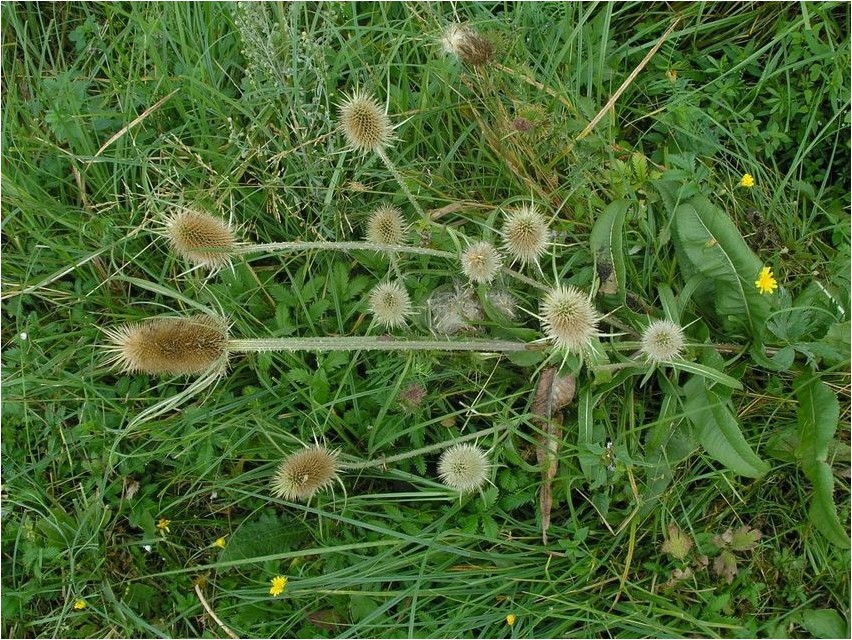
Teasel is one of the plants of the family called teasel; in Latin the name of this plant will be as follows: Dipsacus sativus Honk.
As for the name of the teasel family itself, in Latin it will be like this: Dipsacaceae Juss.
Description of teasel
Teasel is a biennial herbaceous plant, endowed with rather tall ribbed and spiny stems, the height of which can range from fifty centimeters to two meters. The basal leaves of this plant are endowed with short petioles; they are collected in a rosette; these leaves will also be oblong-obovate, their length will be about twenty to thirty centimeters. As for the stem leaves, they will be opposite and fused at the base, and also oblong-lanceolate. The length of the flower head will be about four to eight centimeters. The bracts of the teasel are found in the form of hooked bristles, which are larger in size than the flowers. The corolla is painted in purple tones, and sometimes it can also be white. Teasel flowering occurs in the summer.
Under natural conditions, this plant can be found on the territory of the European part of Russia in the Lower Don and Black Sea regions, as well as in Crimea and Ukraine: namely in the Dnieper region and the Carpathians. Quite rarely, fuller’s teasel can also be seen in the Caucasus in the Ciscaucasia region. To grow, this plant prefers shrubs, weedy places and river valleys.
Description of the medicinal properties of teasel
Teasel is endowed with quite valuable medicinal properties; for this purpose, the seeds, flowers, roots, leaves and grass of this plant should be used. The term grass includes flowers, stems and leaves. Such very valuable medicinal properties are explained by the plant’s content of carbohydrates, caffeic acid, the flavonoid siponarin, iridoids and beta-methyl glycoside. In homeopathy, this plant has become quite widespread for rheumatism, gout, skin diseases and pulmonary tuberculosis. It is noteworthy that preparations prepared on the basis of teasel roots are endowed with quite valuable diaphoretic and diuretic effects.
Infusion and decoction prepared from the roots of this plant are recommended for use for syphilis, eczema, psoriasis and pulmonary tuberculosis. An alcoholic extract based on the roots and herb of teasel is used as a painkiller for rheumatism, gout, as well as superficial cracks in the skin and mucous membranes of the lips, chest, fistulas and dermatoses. The coarsely crushed herb of this plant has the ability to cause local anesthesia; for this reason, a decoction of teasel herb is recommended for use in arthritis.

It is noteworthy that previously the inflorescences of this plant were used in the manufacture of cloth. Teasel also serves as an excellent source of green dye for varnishes, oils and wool.
For rheumatism, gout, as well as for superficial cracks in the skin, mucous membranes of the lips, fistulas and dermatoses, the use of the following remedy is recommended: to prepare it you will need to take ten grams of crushed roots or fifteen grams of dry crushed herbs in about one hundred milliliters of seventy percent alcohol. You should take twenty-five to thirty drops per tablespoon of water three times a day.
For pulmonary tuberculosis, the following remedy will be effective: you will need to take the juice of teasel leaves and flowers, one tablespoon two to three times a day.





