Hibiscus ternatea
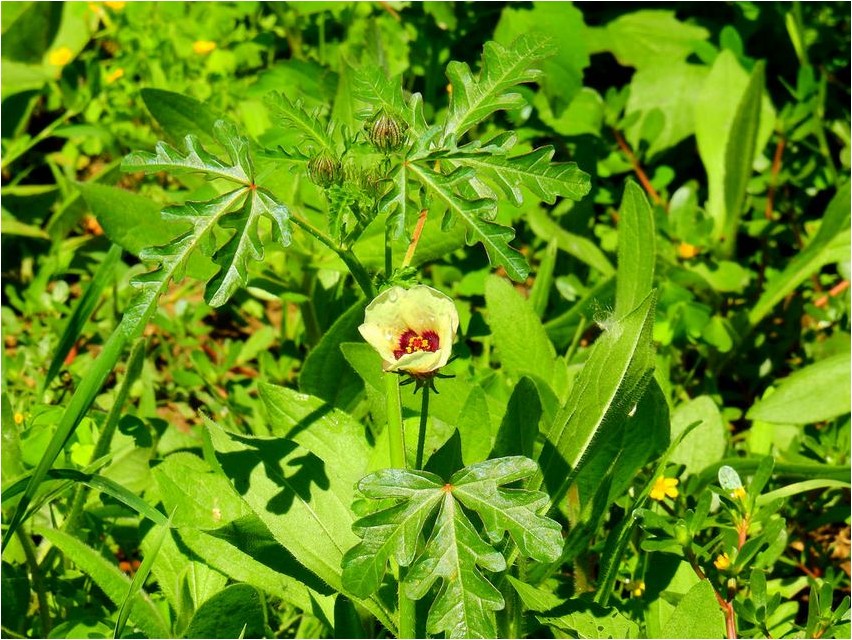
Hibiscus ternatea is a member of the Malvaceae family. Its Latin name is Hibiscus trionum L. (H.
ternatus Cav.). The Latin name for Hibiscus ternatea is Malvaceae Juss.
Description of Hibiscus ternatea
Hibiscus ternatea is an annual herbaceous plant, growing between five and seventy-five centimeters in height. Its stem is erect, but mostly branched. Its leaves are borne on petioles, the petioles themselves densely and stiffly hairy, and the blade may be entire or slightly lobed. Hibiscus ternatea flowers are borne in the leaf axils and are either solitary or on long peduncles. The calyx is bell-shaped, pale, and has twenty purple veins. The corolla is approximately seventeen to thirty-three millimeters in diameter, with the corolla being one and a half to two times larger than the calyx. The corolla is pale yellow in color, with a large purple spot at the throat and along the lateral edges of the petals. The seeds of this plant are kidney-shaped and convex.
Hibiscus ternatea blooms from June to October, and fruiting occurs from June to November. In the wild, this plant can be found in the Primorye and Amur regions of the Far East, as well as in the European part of Russia and the Daurian region of Eastern Siberia, as well as in the Caucasus, Central Asia, and Moldova. In addition, Hibiscus ternatea can also be found in the following regions of Ukraine: the Dnieper and Black Sea regions, as well as in the south. Generally, the plant grows in southern Europe, China, Japan, Africa, Australia, America, the Balkans, Iran, Asia Minor, India, Tibet, Mongolia, and Indochina.
This plant prefers steppe and desert slopes, rocky, gravelly habitats, as well as river valleys and lakeshores on sandy and sandy-pebbly banks. It is noteworthy that the plant is sometimes also found as a weed in crops. Hibiscus ternatea is also a honey plant and is particularly decorative.
Description of the medicinal properties of Hibiscus ternatea
Trifoliate hibiscus is endowed with quite valuable healing properties, and for medicinal purposes it is recommended to use the grass, roots, leaves, fruits, seeds and bark of this plant. The term herb includes the leaves and stems of Hibiscus trifoliata. All parts of this plant contain rubber-like substances. The aerial part of Hibiscus trifolium contains flavonoids, as well as neutral and acidic polysaccharides, arabinose, rhamnose, traces of xylose, galactose and galacturonic acid. The seeds of this plant contain fatty oil.

This plant is endowed with very valuable antibiotic properties, which are aimed at Staphylococcus aureus. An infusion prepared from the herb of this plant is used as a diuretic. It is noteworthy that the diuretic effect of the infusion, tincture and extract from the leaves of Hibiscus trifoliata was confirmed in the experiment. In addition, an infusion of the herb of this plant has an effective effect against rabies.
A decoction of the roots, bark and herbs of this plant is used as an emollient in Chinese medicine. A decoction and syrup of the leaves of this plant is a diaphoretic. At the same time, an infusion of the leaves of this plant is used as an expectorant for coughs. Fresh leaves of this plant are also effective for removing warts. An infusion of the flowers of this plant is used for various skin diseases, itching, and even as a diuretic. The oil of this plant is also used for food purposes, as well as for soap making.





