Kokushnik mosquito
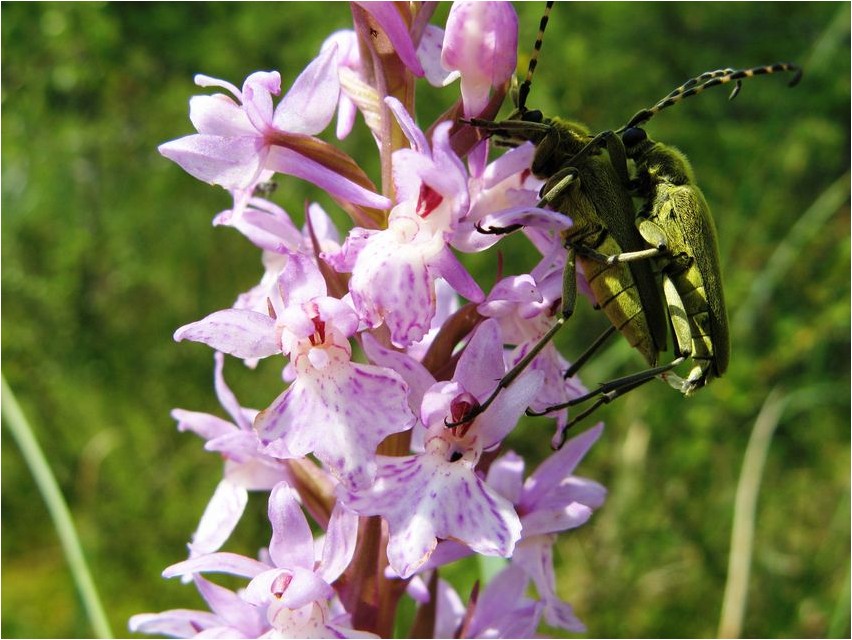
Kokushnik mosquito is one of the plants of the family called orchids; in Latin the name of this plant will be as follows: Gymnadenia conopsea R. Br.
As for the name of the mosquito family itself, in Latin it will be: Orchidaceae Lindl.
Description of the Mosquito Kokushnik
Kokushnik mosquito is a perennial herbaceous plant, the height of which will fluctuate between twenty and seventy centimeters. At the very base, the stem of this plant will be covered with brownish sheaths; above there are approximately four to seven linear-lanceolate leaves, which are pointed at the apex. These leaves will be more or less cap-shaped, with the upper leaves being softer. The tubers of this plant are laterally compressed and will be serrated with four to six lobes. The inflorescence of Kokushnik mosquito is quite dense, multi-flowered and cylindrical. The flowers of this plant are colored either light purple or lilac-pink. It is noteworthy that the flowers will be endowed with a very faint smell of carnation flowers. The ovary of this plant is strongly twisted and its length is approximately eight millimeters.
Flowering of the Kokushnik mosquito occurs during the period from June to July. Under natural conditions, this plant is found in the European part of Russia, Ukraine, Belarus, the Caucasus, the Far East, Western and Eastern Siberia. As for the general distribution, the mosquito moth is found in the Western Mediterranean, Asia Minor, Afghanistan, Mongolia, Korea, Japan, North-Eastern and North-West China, Iran, Central and Atlantic Europe. For growth, the plant prefers bushes, forest clearings and meadows, as well as moderately dry and moist soils.
Reproduction of this plant most often occurs by seeds, and rarely can be done through tubers. It should be noted that the germination of kokushnik mosquito seeds is underground. Approximately in the third year, the green leaf of this plant will appear, and it will bloom approximately in the sixth or seventh year, and most often flowering occurs somewhat later. The plant will be pollinated by beetles, bees and flies, butterflies. Sometimes self-pollination of the mosquito mosquito can also occur. It should be noted that this plant very often hybridizes with other plant species.
Description of the medicinal properties of mosquito kokushnik
Kokushnik mosquito is endowed with very valuable healing properties, and it is recommended to use the tubers and roots of this plant for medicinal purposes. Tubers should be harvested in the autumn. To do this, you will need to dig up the plant, separate the root from the stem, rinse the roots well in water, removing small roots. Then such raw materials should be placed for some time in a vessel containing boiling water. After this, the raw materials are removed and left to dry in the sun.

The presence of such valuable healing properties should be explained by the content of mucous substances, starch, mineral salts, glycosides, protein, sugar and calcium salt of oxalic acid in the composition of the roots of Kokushnik.
As for traditional medicine, the tubers of Kokushnik mosquito have become quite widespread. The roots of this plant are recommended for use when the body is weakened after suffering a serious illness, as well as for leucorrhoea, cough, neurasthenia, impotence, chronic diarrhea, blood stagnation, painful tumors and minor injuries.





