Evening primrose
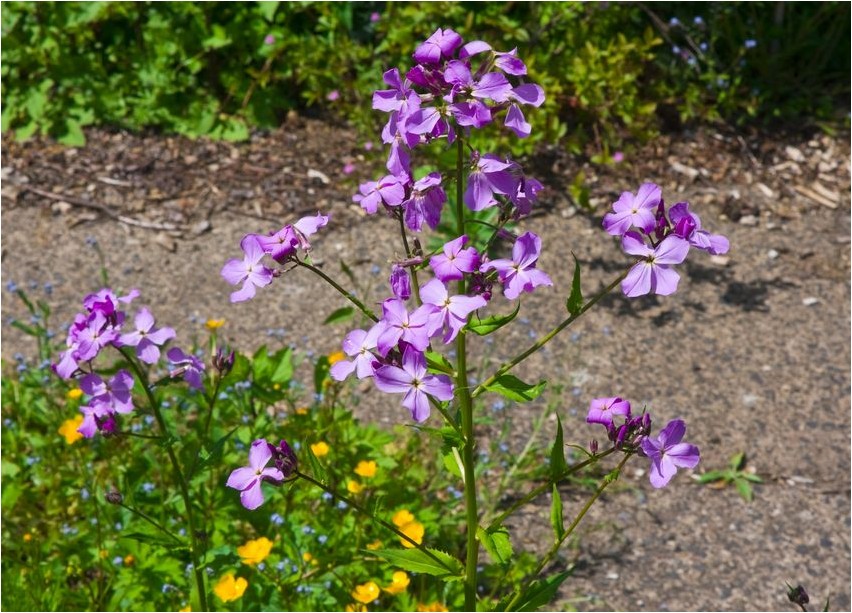
Evening primrose is also known as the night violet. The Latin name for this plant is Hesperis matronalis L.
Evening primrose is a member of the cabbage family, Brassicaceae Burnett.
Description of Evening primrose
Evening primrose is a biennial herbaceous plant that can grow between forty centimeters and one meter in height. The pubescence of this plant consists of both simple and branched hairs. The stems of this plant are erect, and branching occurs only in the inflorescences. The leaves are lanceolate, slightly toothed, and quite pointed. The petals are a rich purple color and are approximately seventeen to twenty-two centimeters long.
This plant blooms either in the spring or early summer. This plant is especially widespread in the European part of Russia, in all regions except the Ladoga-Ilmen, Karelo-Murmansk, and Dvina-Pechora regions. It is also found in all regions of Western Siberia, with the exception of the Altai region. The plant also grows in Crimea, the Caucasus, Moldova, Ukraine, throughout the Mediterranean, the Balkans, Asia Minor, Northern Iran, and Armenian Kurdistan.
Description of the medicinal properties of vespertium
Evening grass has valuable medicinal properties; the leaves, seeds, and herb of this plant are used medicinally. The herb consists of flowers, leaves, and stems. This plant contains flavonoids, essential oil, and saponins. The following cardeloids have been found in vespertium seeds: erysimine and corchoroside, as well as a fairly fatty oil, hesperalin, and alkaloids. In addition, evening primrose also contains steroids such as cholesterol, brassicasterol, beta-sitosterol, and campesterol.
A decoction made from the seeds and herb has a beneficial effect on rheumatism and gout. Moreover, this decoction is also used in folk veterinary medicine. Infusions and decoctions of this herb are also used as a diaphoretic and even diuretic. Similar infusions and decoctions are also effective for cataracts of the upper respiratory tract. It is noteworthy that an alcoholic extract of evening primrose leaves is also characterized by a fairly high degree of antibacterial activity.

Among other things, the essential oil of this plant, with a certain degree of organoleptic evaluation, is characterized by a fairly high distribution in perfumery, and the fatty oil of noctule seeds is used in soap making.
For gout and rheumatism, it is recommended to take two tablespoons of a decoction of this plant three times a day. To prepare, it is recommended to take one teaspoon of seeds per glass of water, boil the resulting mixture for about six to seven minutes, and then leave to steep for two hours. Subsequently, this mixture is filtered and can already be consumed.
For gout, rheumatism and catarrh of the upper respiratory tract, it is recommended to use a decoction of this plant as a diuretic and diaphoretic. To prepare, you need to take two tablespoons of chopped dry noctule grass for about a glass of boiling water. This mixture is infused for two hours and then filtered. Take this mixture one or two glasses three times a day.
Vechernitsa is characterized by very valuable medicinal properties, which are reflected in the quite effective treatment of a number of diseases.





