Chinese cabbage
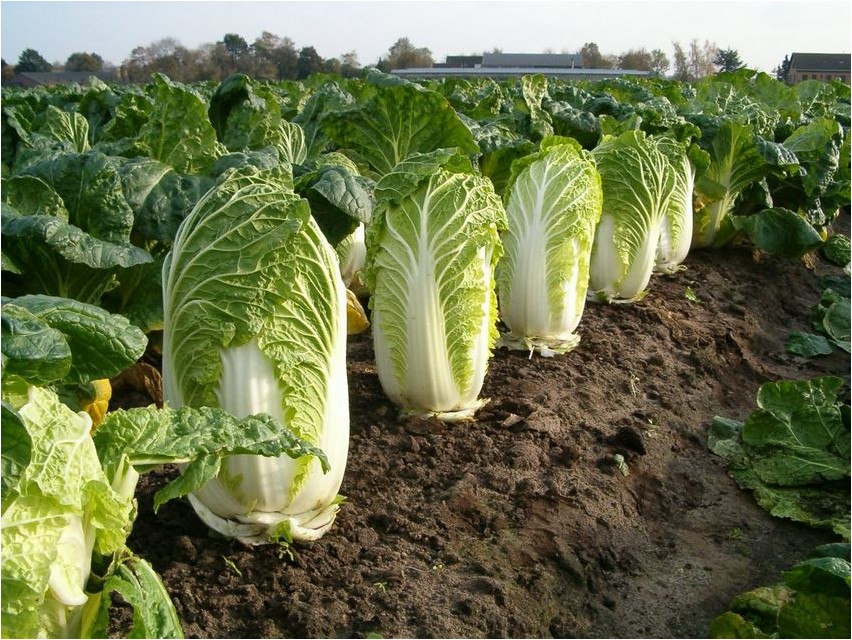
Chinese cabbage (lat. Brassica rapa) is represented by biennial plants of the Cruciferous, or Brassica, family. The plant is also called pak choi or mustard cabbage.
The homeland of the plant is China. Currently, this species in question is cultivated in China and the Korean Peninsula. In Russia, the plant is cultivated only in the Primorsky Territory.
Description
Chinese cabbage is an annual plant that produces large, erect rosettes of leaves as it grows. The culture does not form heads of cabbage. The rosette consists of smooth, less often vesicular, rounded leaves. Most of the leaves are equipped with juicy green petioles, the other part has white petioles. The continuation of the petioles is the central vein of the leaves.
The peduncles of the species in question are quite long, they bear small whitish or yellow flowers. The fruits are represented by short pods that crack easily when ripe.
Chinese cabbage has high cold-resistant properties, and it is practically not affected by pests and diseases. The only negative factor that can affect the growth cycle is low temperatures when seedlings emerge. The crop produces good yields and is well stored.
Subtleties of cultivation

It is preferable to grow Chinese cabbage in loose, moist soils filled with organic matter. Damp, dry, waterlogged, heavy, saline and highly acidic soils are not suitable.
Chinese cabbage belongs to the category of light-loving crops; it thrives in open sunny areas, openwork shade is not forbidden. The temperature to maintain normal growth is 18-20C. The crop does not tolerate higher temperatures well. The best predecessors of the crop are cucumbers.
Sowing the seed
Chinese cabbage is sowed immediately in open ground, since it has a negative attitude towards transplantation and often does not take root. The first sowing is carried out in April under film cover. You can grow the species in question through seedlings, although you will have to purchase peat pots for sowing. They are filled with a nutrient mixture. Sowing Chinese cabbage in the third ten days of May — the first ten days of June is undesirable, since the cabbage quickly enters the stalking phase. To obtain an autumn harvest, the crop is planted in the second ten days of August.
It is not forbidden to grow the plant indoors at any time of the year. Sow cabbage, keeping a distance of 30 cm. The seeds should not be planted deeply, 1. 5-2 cm is enough. 2-3 seeds are planted in one hole. With the seedling method, seedlings are planted in the ground until five leaves appear on them. Young plants are planted together with pots. You can grow Chinese cabbage as a compactor for other vegetable crops.
Care
Chinese cabbage needs systematic watering, fertilizing, removing weeds, loosening the rows, as well as preventive treatments against pests and diseases. This type of cabbage does not require hilling.
In general, Chinese cabbage is resistant to pests; in rare cases, it is affected by cruciferous flea beetles. As a preventive measure, plants and soil are periodically dusted with wood ash and black pepper. The crops are thinned until 1-2 true leaves appear on the seedlings. It is recommended to leave no more than 1 specimen in the hole.
Watering is carried out regularly; it is not recommended to allow the soil to dry out, since the species in question has a superficial root system. The plants are fed with complex mineral fertilizers. Organic matter is added in early spring.