Ledeburia
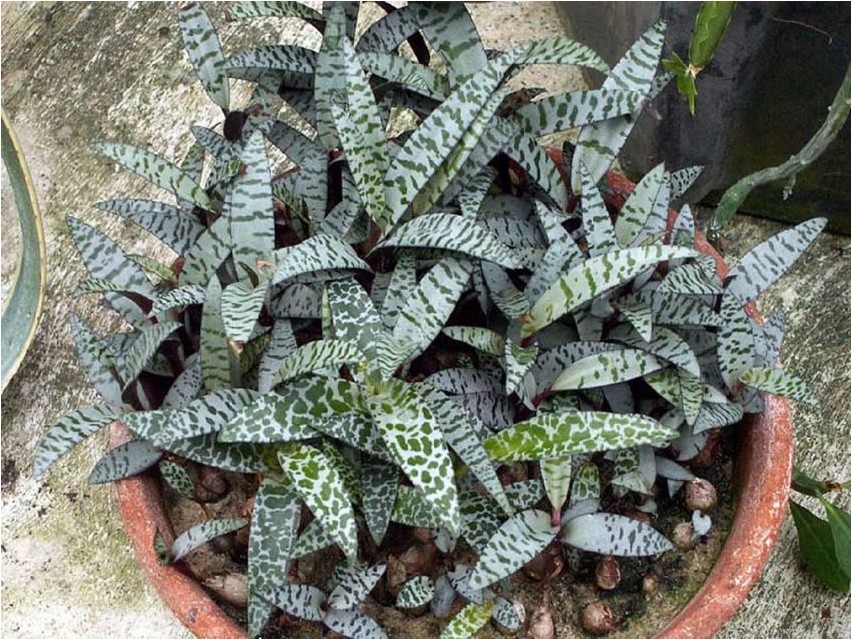
Ledeburia (lat. Ledebouria) is a genus of bulbous plants native to South Africa, classified by botanists as belonging to the Asparagaceae family (lat. Asparagaceae).
In areas with cold winters it is grown as a houseplant. The plant gained its popularity among gardeners for its original leaves with a spotted surface and inflorescences of small flowers resembling miniature bells or barrels.
What’s in your name
The Latin name of the genus “Ledebouria” immortalizes the name of a German botanist who was in Russian service in the first quarter of the 19th century. His name is Carl Friedrich von Ledebour. Working in Russia, Lideboer, together with the students of the school of florist-systematists, which he first founded in Russia, did a great deal of work on the taxonomy of plants in our country.
He was not just an office worker, but made trips to areas with little-studied vegetation, where he collected herbariums and made descriptions of plants. One of these trips was an expedition to Altai, little studied at that time, where over the course of nine months Ledebur, in company with two other botanists, his students, managed to collect about 1, 600 species of Altai plants, a quarter of which were new species. Such a wealth of information fit into four volumes written by Ledebour. The descriptions were accompanied by excellent illustrations.
The plant genus Ledeburia was described at different times by different botanists, who assigned it to different families. Therefore, in the literature you can find, for example, that the genus Ledeburia belongs to the Liliaceae family (lat. Liliaceae).
Description
The basis of plants of the genus Ledeburia is a violet-purple or brownish bulb that feeds the above-ground part and is responsible for their long-term life. The emerging daughter bulbs give birth to new rosettes of leaves, forming a dense carpet on the surface of the earth.

The bulbous rosette is formed by erect, smooth leaves, which can take different shapes depending on the type of plant (elliptical, broadly lanceolate or lanceolate). The number of leaves in a rosette varies from one to several pieces. The leaves can be single-colored or spotted, with dark green or purple spots standing out against a silver-green background.
Loose racemes-inflorescences, rising on peduncles-arrows above a rosette of leaves, are formed by small, numerous (from 20 to 50 pieces) flowers, colored from bright lilac to dark pink or purple. There may be green or yellowish-green inconspicuous flowers with a characteristic green stripe in the center of each petal.
Varieties
* Ledebouria socialis (lat. Ledebouria socialis) is a species popular as a houseplant. It is distinguished by a compact rosette of silver-gray leaves with olive-colored streaks and spots on their surface, unpretentious disposition, and rapid growth. Propagated by daughter bulbs.
* Cooper’s Ledeburia (lat. Ledebouria cooperi) – also grown as a houseplant. The dark green leaves of the plant are decorated with purple stripes, and the numerous small flowers, forming clusters, are pink-purple with green stripes in the center of the petals, or with green tips.
* Ledebouria crispa (lat. Ledebouria crispa) is a species on the list of endangered plants.
* Ledebouria revoluta is a species most common in eastern South Africa. It is distinguished by its diversity and variability of appearance.
* Ledebouria lepida (lat. Ledebouria lepida) is a rare species that needs human protection from complete extinction from the face of the Earth.
Healing abilities
Some species of the genus Ledeburia are used for medicinal purposes for diarrhea, back pain, flu, and skin irritations.
Although plants of the genus have a reputation for being poisonous, African Bushmen use the bulbs of “Ledebouria revoluta” and “Ledebouria apertiflora” in their diet.
Growing conditions
As a rule, plants of the genus Ledeburia are easily cultivated through sowing seeds. Flowering in this case occurs after three years. It is easier to propagate by leaf cuttings or daughter bulbs.
Most species like full sun and well-drained soil. Watering is carried out only during the summer growing season, stopping watering during the winter rest period.