Veronica longifolia
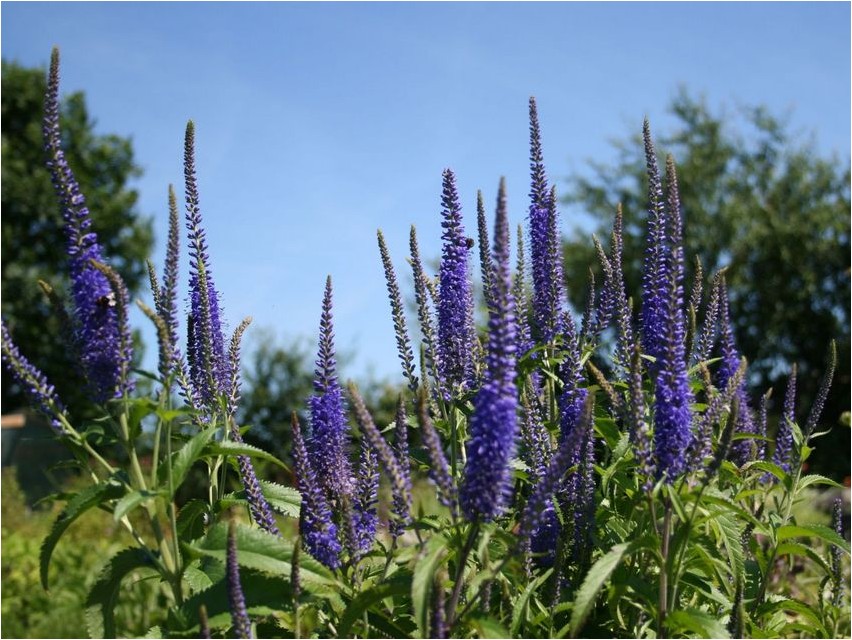
Veronica longifolia is part of the family called Noricaceae; in Latin the name of this plant is as follows: Veronica longifolia L.
Description of Veronica longifolia
Veronica longifolia is a perennial herbaceous plant that is endowed with a rather long creeping rhizome. This rhizome is almost completely naked, and in the upper part it will be short pubescent. The stem of Veronica longifolia is erect; in inflorescences, the stem is sometimes slightly branched, and the height is about fifty to one hundred and twenty centimeters. The lower leaves of this plant are collected in a rosette; the leaves can be either rounded or lanceolate. In addition, the leaves are serrated or entire-edged, and also somewhat thick and endowed with a winged petiole. The stem leaves are sessile, with the lower ones being opposite and the upper ones alternate, toothed, lanceolate or entire. The flowers of Veronica longifolia are painted in bluish-lilac or blue tones, the flowers are found one at a time on pedicels in the axils of the bracts, and at the very top of the stem and branches they are collected in rather fluffy long racemes. The fruit of the plant is a capsule, somewhat flattened, notched and obversely cordate.
Veronica longifolia is found in natural conditions in the European part of Russia, in the Crimea, the Caucasus, Ukraine, Siberia, as well as in Central Asia and the Far East. The plant prefers damp places, forests, banks of streams and canals; the plant can often be found among bushes.
Description of the medicinal properties of Veronica longifolia
For medicinal purposes, the stems, leaves, flowers and roots of Veronica longifolia should be used. It is noteworthy that the chemical composition of this plant has not yet been particularly studied. However, it has been proven that this plant contains saponins, as well as the following flavonoids: aucubin, cynaroside and luteolin. The roots of this plant contain saponins, and the grass contains carotene, ascorbic acid, tannins, choline, caffeic and chlorogenic acid. It has been scientifically proven that Veronica longifolia has a special antistaphylococcal activity.

The plant is also characterized by antimicrobial, hemostatic, anti-inflammatory, analgesic and emollient effects. Veronica longifolia is used to treat a variety of colds, as well as hemorrhoids, cystitis, bronchitis, pulmonary tuberculosis, and in addition, the plant is also effective for headaches, aches and as a pain reliever after childbirth.
As for traditional medicine, the use of Veronica longifolia herb for uterine bleeding has become quite widespread, while the roots are used for endometritis and enterocolitis. Fresh leaves of this plant can be applied between the toes to prevent excessive sweating. Previously, an infusion of the herb was used to wash wounds and snake bites, and in such cases, the use of a decoction and infusion of the herb is also effective. For ringworm, poultices can be used. The flowering tops of this plant were fried in lard and then used as a poultice for diphtheria and scarlet fever. For jaundice and neuropsychiatric disorders, it is recommended to use a decoction prepared from the roots of this plant. In homeopathy, the roots of the plant are used for their good choleretic effect.
For colds, you will need to take a teaspoon of herb in a glass of boiling water, then leave the mixture to steep for two hours. It is recommended to take this decoction half a glass per day.





