Povoy fence
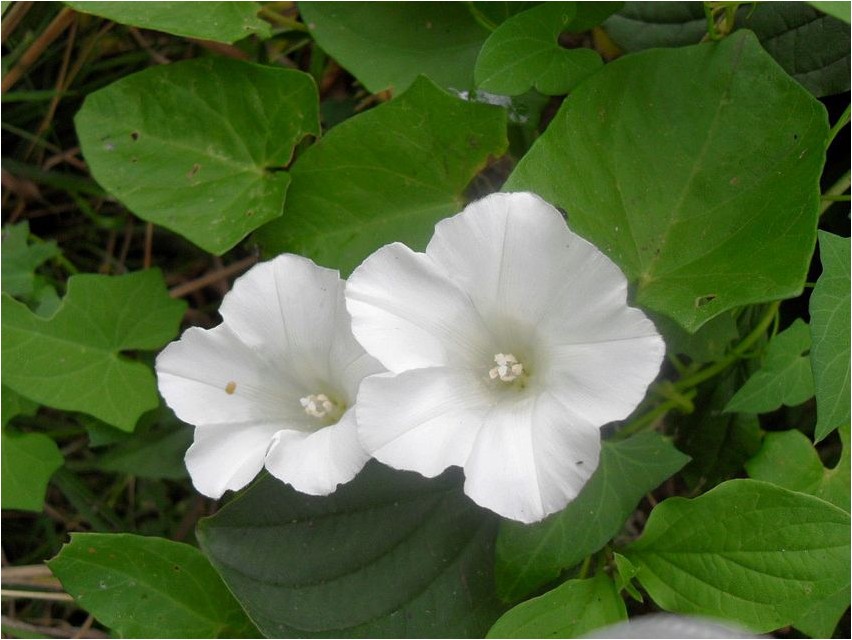
Povovy zaborny is one of the plants of the family called Convolvulaceae; in Latin the name of this plant will sound as follows: Calistegia sepium (L.) R. Bg.
As for the name of the fence root family itself, in Latin it will be: Convolvulaceae Juss.
Description of the fence rootstock
Povovo zaborny is a perennial naked plant, endowed with a horizontal rhizome, the length of which reaches three meters. The stems of this plant are long, curly and weak. The leaves of the fence rootstock can be either triangular-ovate or triangular; they are endowed with a rather sharp tip and angular leaves, and at the very base such leaves will be heart-shaped. The flowers of the fence rootstock are painted pink or white, and the length of the bracts will be about three centimeters. The length of the corolla of this plant is four to six centimeters, and the box itself will be round in shape.
Fence rootstock blooms in the summer. Under natural conditions, this plant is found in Central Asia, Crimea, Belarus, Ukraine, the Daursky region of Eastern Siberia, all regions of Western Siberia with the exception of the Ob region, as well as in all regions of the European part of Russia, except for the Dvina-Pechora and Karelo-Murmansk. For growth, this plant prefers swamps, places near trees, among reeds, near fences, in gardens, fields, thickets of bushes, irrigation canals, banks of rivers, oxbow lakes, irrigation ditches, lakes and streams, ranging from the lowlands to the mid-mountain zone. It is noteworthy that the honey plant is not only a very valuable honey plant, but is also an ornamental plant.
Description of the medicinal properties of fence root
Povova fence is endowed with very valuable healing properties, and for medicinal purposes it is recommended to use the roots, rhizomes and grass of this plant. The concept of grass includes the stems, flowers and leaves of this plant. The presence of such valuable healing properties is recommended to be explained by the content of alkaloids, tannins, steroidal saponins, vitamin C and flavonoids in this plant.
It’s worth noting that remedies based on this plant have become quite widespread in Chinese medicine. A decoction prepared from the rhizomes and roots of the rhizome … In Central Asia, the powdered grass of the common rhododendron is used as a very effective wound-healing agent, particularly recommended for burns.

It should be noted that the extract from this plant’s grass has valuable antitumor activity. Fresh leaves of the common rhododendron are used for furunculosis, and are also used as a pain reliever and wound-healing agent. Yarn and fiber are produced from the stems of this plant.
Common rhododendron





