Hamedafne
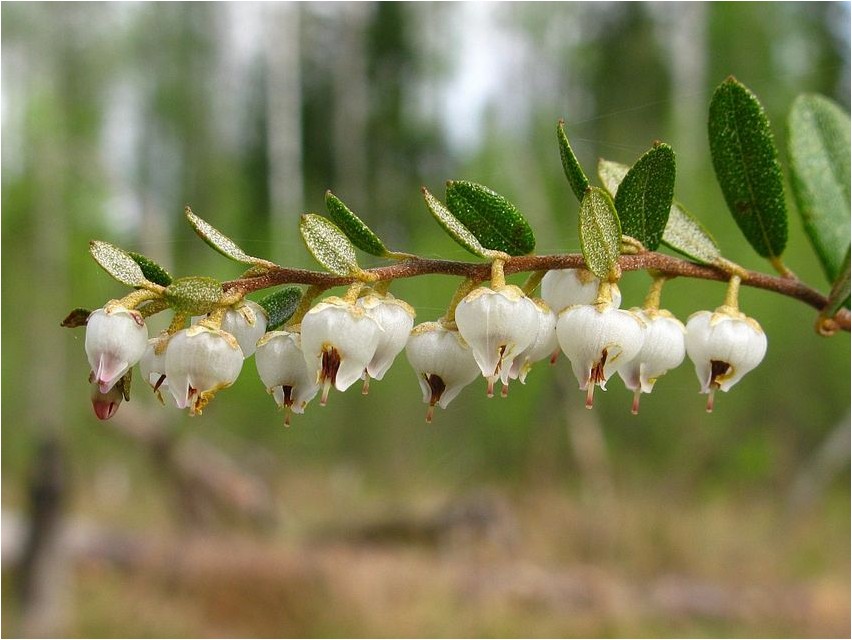
Hamedaphne (lat. Chamaedaphne) is a genus of perennial plants belonging to the Heather family. Other names: chamedaphne, swamp myrtle, cassandra.
In nature, plants are common in both warm and cold regions of the Northern Hemisphere. Hamedaphne is especially abundant in North America, China, and Europe. Plants are also found on the territory of Russia, both in the European part and in Siberia. Typical habitats are sphagnum bogs and swampy woodlands.
Characteristics of culture
Hamedafne is represented by perennial evergreen branched shrubs no more than 1 m high. The plant has a superficial root system, which consists of adventitious roots. By the way, they form on shoots immersed in moss. The stem of Hamedaphne is straight, young branches are pubescent.
The foliage is flat, oblong, sessile, alternate, leathery, oval or lanceolate, with curled edges. The color of the foliage ranges from dirty green to dark green with an admixture of brown or even whitish tint. An interesting feature of Hamedafne foliage is the presence of small rusty scales on the surface of the foliage.
The flowers are white, bell-shaped, equipped with bracts and short pedicels, collected in racemose drooping inflorescences. Flowering occurs in late spring – early summer and lasts until the end of July. The fruits are represented by five-leaf capsules of a spherical, slightly flattened shape. It begins to bear fruit at the end of July.
Application of the plant
Hamedafne belongs to the category of poisonous plants. This is due to the content of andromedotoxin in the glycoside. It is found in foliage and young shoots. In large quantities it can cause poisoning and even death. However, the plant is actively used in folk medicine in minute quantities. It is very important to consult a doctor before use!

Hamedafne is recommended for use as a sedative and antirheumatic agent. The plant is also famous for its analgesic properties, and externally, for example, by adding an infusion to a bath, it can be used as an antiseptic. Feelings of drowsiness, increased salivation, nausea, vomiting, weakness indicate an overdose, you should stop taking it, drink activated charcoal and consult a doctor immediately.