Kvamoklit
Quamoclit (lat. Quamoclit) is a climbing perennial or annual, a member of the Convolvulaceae family. The second name of this plant is mine.
Description
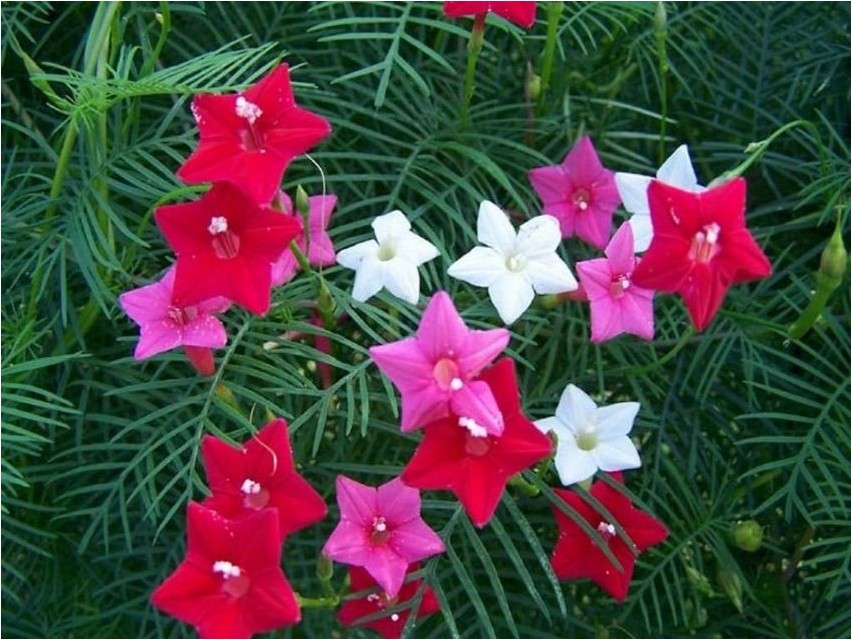
Kvamoklit is a liana plant endowed with twisting and quite powerful stems, the length of which often reaches four to five meters. Its leaves are dissected, fan-shaped and painted in pleasant light green shades. As for the flowers, they are always tubular in shape and have an impressive brightness — their color scheme is literally replete with stunning shades of red, pink and white.
Flowering of quamoclite starts from the very first warm days of summer, and it continues until autumn. By the way, the flowering of this amazing plant has its own characteristics — early in the morning, when the sun rises, the quamoclite flowers gradually bloom, then throughout the hot day they will be closed, and when the sun begins to set, they will bloom again.
Where does it grow
Quamoclite is a plant native to Central and South American lands. It is there that it grows in huge quantities to this day.
Usage
Most often, quamoclite is used in landscape design. The most valuable annual for ornamental gardening is the pinnate quamoclite, the height of which can reach five meters. This plant boasts incredibly delicate finely dissected leaves and stunningly beautiful white or red flowers, which are characterized by a regular star-shaped shape. This amazing plant blooms from July until September.
Kvamoklit is widely used for decorating balconies, terraces, pyramids on lawns and pergolas.

Growing and care
Kvamoklit is extremely thermophilic, therefore, in order for it to please with its full development, it must be planted in sunny areas. As for the soils, they must be well cultivated and without excess fertilizer.
In the middle zone, seeds are usually sown in March. First, they are sown in boxes (do not forget to soak them for a day in warm water immediately before sowing), and after a while the hatched seedlings dive into pots. And the beautiful plant is planted in the ground in early June, when all possible frosts have passed. In this case, the depth of seed placement should not exceed one centimeter. It is best to plant this plant in sunny, well-warmed areas. As for soils, quamoclite is completely unpretentious to them, however, if you want it to please the eye with its flowering for as long as possible, it is advisable to plant it in loose areas with fertile soil or soil that contains at least a small amount of humus or sand.
Since quamoclite is very moisture-loving, it must be watered regularly and generously (at least once every three to four days). However, under no circumstances should you allow water to stagnate — this can destroy a beautiful plant. As a rule, no more than one liter of water is consumed per plant, but in hot weather it is quite acceptable to increase the volume of water.
It is recommended to apply good complex mineral fertilizers to the soil approximately three to four times a month, and as soon as autumn comes, fertilizing is stopped immediately.
And one more important nuance — quamoclite is characterized by extremely intense, rapid growth, so its powerful and fairly long shoots must be systematically tied up. And this should be done strictly vertically — by forming different directions of shoot growth, you can create fancy compositions without much difficulty.
Quamoclite propagates mainly by seeds — in this case it will show the best results when grown in open ground.