Peas (Vika)
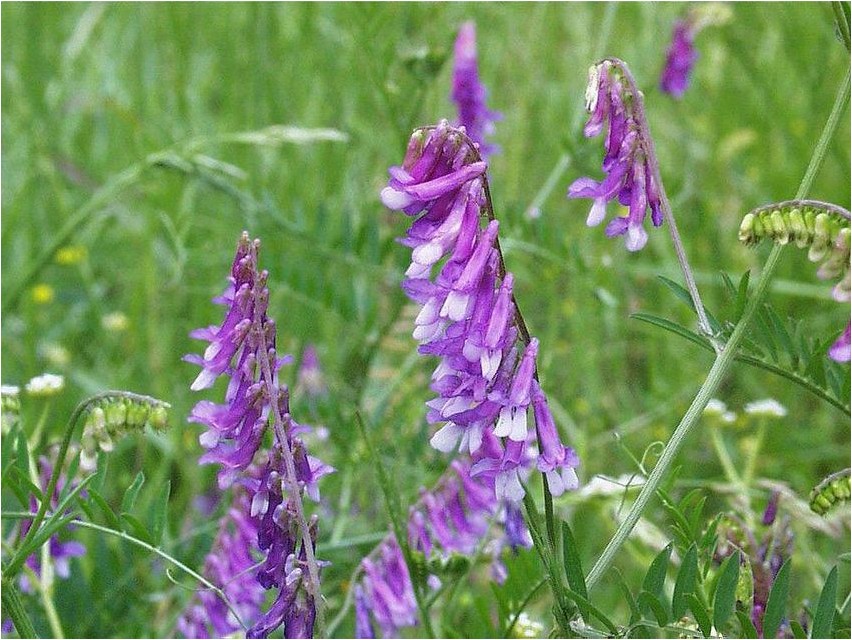
Vetch (lat. Vicia) is a numerous genus of plants belonging to the legume family (lat. Fabaceae). In common parlance, the genus is called “Pea”. The genus is not only numerous, but also omnipresent.
Plants can be found on all continents, excluding Australia and Antarctica. Vicky”s closest relatives in the Legume family are True Peas (Latin: Pisum) and Lentils (Latin: Lens).
Description
Among the numerous representatives of the genus, perennial plants are more common, but annuals are also found.
From roots with nodules of an indeterminate type that provide shelter for bacteria that can fix nitrogen, erect or climbing stems emerge into the world.
The complex pinnate leaves of the plants are composed of pair-pinnate simple ovoid leaflets. The end of the leaves has a branched tendril, with which the plant clings to the available support. Sometimes the antennae are not branched, or are represented by straight bristles.
Flowers, which have a shape characteristic of plants of the legume family, appear from the axils of the leaves and can be single or grouped in groups of 2-3 pieces. Sometimes they form an inflorescence-brush, located in a large group along the peduncle. The petals are colored from white to blue or purple, but sometimes yellow or red are found. Pollinators are insects, including bumblebees and honey bees.

The pollinated flower gives birth to a flat-compressed bean pod, inside of which there are from two to several seeds.
Varieties
* Mouse peas — lat. Vicia Cracca
* Hairy pea — lat. Vicia hirsuta
* Multi-stem peas — lat. Vicia multicaulis
* Peas (or, Vetch) — lat. Vicia sativa
* Thin-leaved peas — lat. Vicia tenuifolia
* Four-seeded peas — lat. Vicia tetrasperma
* Hairy pea — lat. Vicia villosa
* Orange peas — lat. Vicia crocea
* Ciliated peas — lat. Vicia ciliatula.
Usage
Certain species of plants of the genus Vica were among the first wild crops that people began to grow for their needs. In the Middle East, archaeological excavations show that people began to grow vetch 9. 5 thousand years ago, and perhaps even much earlier. In Central Europe this happened 7 thousand years ago, and in Indochina — 11 thousand years ago. Vika is also mentioned in later times of history, including in ancient Egyptian and Hebrew texts.
Later, when people learned to grow more nutritious and more productive legumes, as well as various cereal plants, Vetch was excluded from the human diet. But she was remembered during famine periods in the history of Mankind, as well as during wars. For example, during World War II in the south of France, Vicki fruits appeared for sale on the black market.
Nowadays, people have not forgotten about the nutritious plant, rich in protein and vitamins, and continue to grow some species of plants of the genus Vetch for livestock feed and for use as green manure. This is facilitated by the plant’s unpretentiousness to living conditions, the rich content of protein and other useful substances, as well as the collaboration of the plant with microorganisms that can fix nitrogen from the air, enriching the soil with an important chemical element for the growth of most terrestrial plants. Vetch is also used as a honey plant, from which bees readily collect nectar.
Dangerous scams
Some people are so designed that they cannot live without cheating in order to receive good income with minimal expenditure of their labor. The fact is that crushed Vetch seeds are similar to crushed Red Lentil seeds. “Enterprising” guys tried to sell crushed seeds of Vicky species with toxic fruits to some countries (India, Pakistan, Egypt), under the guise of Lentils, which is very popular in these countries. Such countries had to establish bans on the import of suspicious products.


