Yams
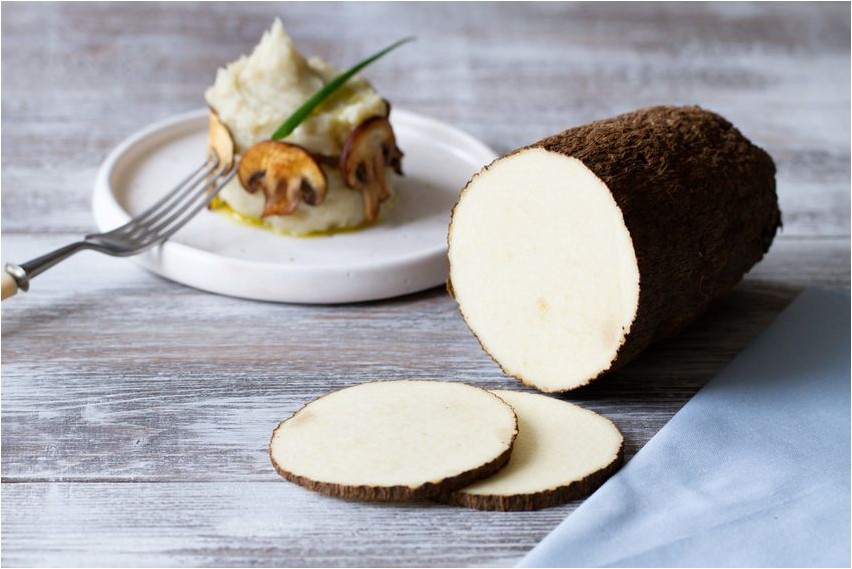
Yam (lat. Dioskorea villosa) is a vegetable crop belonging to the Dioscoreaceae family and is a tuberous perennial plant with climbing shoots and edible roots.
Description
Yams have a widely branched fibrous root system. Its ribbed thin stems can be either curly or lodging. Sometimes they reach a length of three meters. The petiolate simple leaves near the bases of the stems are always opposite, and a little higher up they are alternate. The rounded leaf blades are endowed with heart-shaped bases and pointed tips and reach a diameter of five to six centimeters. The length of the leaf petioles is about twelve centimeters. Sometimes sharp spines can be seen near their bases.
Yam flowers are formed extremely rarely — this plant does not reproduce generatively.
Numerous stolons (side shoots) are formed on the underground parts of yam stems, as well as in the area of root collars. Each plant usually has from four to twenty stolons ranging in length from five centimeters to half a meter. By the way, their length is an important varietal characteristic of this crop: according to this indicator, it is customary to distinguish loose-bush (spreading), medium-dense and compact varieties. And yam tubers form precisely on the thickening tips of the stolons.
The length of yam tubers can reach two and a half meters, and their weight sometimes reaches seventy kilograms. On average, the weight of tubers varies from fifty to three hundred grams to ten to fifteen kilograms. The smallest tubers are usually left for later propagation. As for their shape, it can be spindle-shaped, elongated oval or round. The surface of the tubers is in most cases smooth, although sometimes there are quite rough specimens. The thin skin is purple, pinkish or white in color, and the flesh is usually yellowish or white.
Nutritional value
Yam is a fairly nutritious product — its raw calorie content is 118 kcal. It contains practically no fat and is very rich in carbohydrates — this feature allows yams to be eaten even by those who are watching their figure.

Usage
Yam tubers are eaten, although they are not used fresh. Unlike other tropical root-tuberous crops, they can be stored for quite a long time even at high temperatures.
Sometimes yam tubers are cut into small pieces, after which they are dried and ground into flour, which is later used to make delicious sauce additives and hearty flatbreads.
This crop is also cultivated for its high starch content — especially large plantations can be found in the subtropics or tropics — in Oceania, Latin America, Asia and Africa.
As for the nutritional value of yam tubers, in this respect they are quite comparable to cassava tubers, but the former contain much more protein.
Growing
For early-ripening yam varieties, the growing season lasts from five to six months, and for late-ripening varieties, from ten to twelve months. It is best to choose neutral, well-aerated and enriched with various nutrients for the soil for planting this crop. In addition, throughout the entire growth period, yams must be provided with sufficient moisture. And the best temperature for its development is considered to be twenty-four to twenty-eight degrees.
The most suitable areas for growing yams will be sunny and fairly warm areas. This crop will grow especially well near trellises, nets, fences and any other supports.