Leek
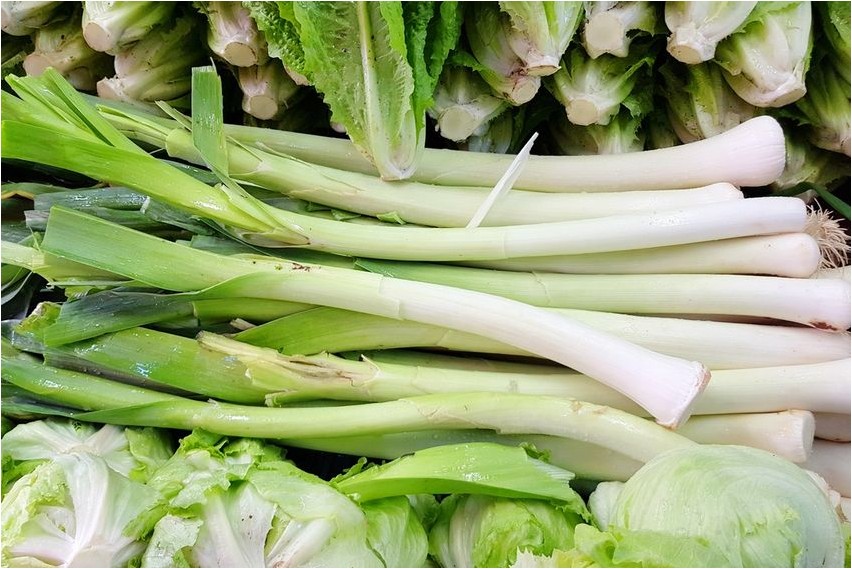
The leek (Latin: Allium porrum) is a biennial plant in the onion family. It is native to the Mediterranean region.
Leeks were bred from the wild plant Allium ampeloprasum, common in the Mediterranean region, Iran, and England. Currently, the crop is grown in large quantities in North Africa, America, France, and other European countries.
Crop Characteristics
Leeks are an ancient and valuable crop. In the first year, leeks develop a robust false bulb, consisting of thickened leaf bases attached to the base and smoothly transitioning into a false stem. The stem is green, white or light green beneath the leaves, and white in cross-section with a yellowish pith. The leaves are flat, linear-lanceolate, green with a waxy coating, fan-shaped, and have a central vein running along their entire length.
In its second year, the plant forms a flower stalk, reaching a height of approximately 1-2 meters. The inflorescence is a spherical umbel, initially enclosed by a sheath, reaching 6-8 cm in diameter. The flowers are small, white, pinkish, or lilac in color. The seeds are triangular, black, and wrinkled; they remain viable for 2-4 years.
Growing Conditions

Leeks are a light-loving crop; they grow and develop well in areas with full daylight. They prefer light, moderately moist, fertile, loamy soils with a neutral pH. The optimal growing temperature is 20-25°C. The best predecessors for leeks are tomatoes, cucumbers, potatoes, cabbage, and legumes.
Growing Seedlings and Planting in Open Ground
Leeks are grown using both seedlings and direct-seeded methods. Before sowing, the seeds are treated with a weak solution of potassium permanganate. To speed up germination, the seeds are germinated by placing them on damp cheesecloth, leaving them in a warm place for 2-3 days, and then drying. Sow at the end of February in seedling trays filled with moistened soil. Plant the seeds at a depth of 1-1. 5 cm.
After sowing, the substrate is watered with a spray bottle, covered with glass or film, and placed in a room with an air temperature of 22-25°C (72-77°F). Once the seedlings emerge, the temperature is lowered to 15-17°C (59-60°F). A week later, the temperature is increased to 17-20°C (59-68°F). Maintaining the correct temperature is crucial for leeks. After a month, the seedlings are transplanted into individual containers, preferably in peat-humus pots. Water the seedlings regularly and feed them with liquid fertilizer.
Planting in open ground is carried out when seedlings reach 6-8 weeks of age. Before planting, seedlings are hardened off. The area for growing leeks is prepared in the fall. The soil is carefully dug up, compost, superphosphate and potassium chloride are added. In spring, the ridges are loosened with a rake. The roots of the plants are dipped in clay mash, and only after that they are planted in the ground. The depth of the holes should be about 10-13 cm. The distance between plants should be 15-20 cm, and between rows — 25-30 cm.
Care
Leeks are a rather demanding crop; they require systematic watering, fertilizing, weeding and hilling. To provide plants with more comfortable conditions and make work easier, the soil on the ridges is mulched.
When the leek stems reach a diameter of 0. 5 cm, soil is poured into the holes, and then regular hilling is carried out. Such procedures produce longer and bleached stems.
The crop is very demanding when it comes to watering and fertilizing, especially in the first half of the growing season. As a fertilizer, it is best to use mullein or bird droppings in the form of solutions in a ratio of 1:8 and 1:20, respectively.
Harvest
Leeks are harvested in August — October, it depends solely on the variety. The plants are carefully dug up with a shovel, the soil is shaken off and placed in wooden boxes. Fold the leeks in a vertical position, or tie them into small bunches. Store leeks in sand at an air temperature of 0-1C.