Broadleaf Marshmallow
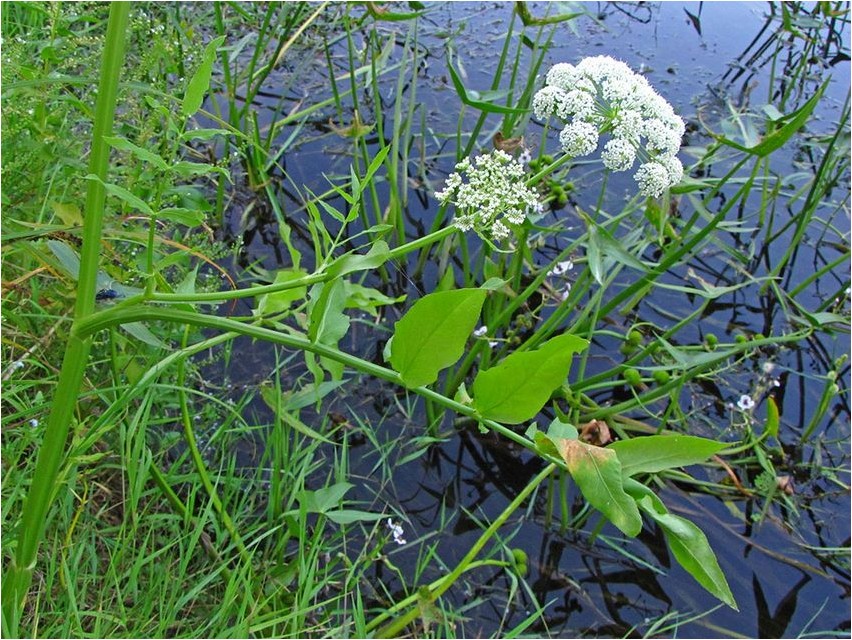
Broadleaf Marshmallow is a member of the Apiaceae family. Its Latin name is Sium latifolium L.
As for the family name of broadleaf Marshmallow, its Latin name is Apiaceae Lindl. (Umbelliferae Juss.).
Description of Broadleaf Marshmallow
Broadleaf Marshmallow is a perennial herbaceous plant, reaching heights between fifty and one hundred and twenty centimeters. Its rhizome is quite thick, bearing whorls of thick roots. The entire plant is glabrous, and its stem is bare and hollow, and can be either faceted or ribbed. The aerial leaves of the broadleaf marsh cinquefoil are simply pinnate, with large, entire, oblong or oblong-lanceolate segments. Submerged leaves are bipinnate or tripinnate, with filiform or linear terminal segments. The leaf petioles are provided with quite noticeable transverse septa. The leaflets of both the involucre and the bract of the broadleaf marsh cinquefoil are recurved downward. The fruit of this plant has thickened ribs and can reach four millimeters in length.
Blooming of the broadleaf marsh cinquefoil occurs in summer. In the wild, this plant is found in Belarus, Ukraine, all regions of the European part of Russia with the exception of the Black Sea region, all regions of Western Siberia except the Altai region, the Angara-Sayan region of Eastern Siberia, and the Aral-Caspian region of Central Asia. This plant prefers muddy and marshy lake and river banks, and is also quite common in both slow-moving and standing water.
Description of the medicinal properties of broadleaf marsh marigold
Broadleaf marsh marigold has very valuable medicinal properties, and its roots and herb are recommended for medicinal purposes. The herb includes the leaves, flowers, and stems.
The presence of such valuable healing properties is recommended to be explained by the content of coumarins and polyacetylene compounds in the roots of this plant, while flavonoids and quercetin will be present in the grass, coumarins and quercetin are found in the stems, and the same elements are found in the leaves. The inflorescences of this plant contain quercetin, kaempferol and coumarins, and the flowers contain kaempferol and quercetin, while the fruits contain higher aliphatic carbohydrates and essential oil.

Latifolia porcurtis is endowed with very effective anti-inflammatory, stimulating, diuretic and anti-scorbutic properties.
For cystitis, it is recommended to use the following quite effective remedy based on this plant: to prepare such a healing remedy, you will need to take two tablespoons of crushed dry grass of the latifolia latifolia per one and a half cups of boiling water. The resulting medicinal mixture should be infused for about one hour, after which this mixture should be filtered very carefully. Take the resulting medicinal product based on latifolia three times a day before meals, one or two tablespoons. It is noteworthy that such a drug can also be used as both an antiscorbutic and a diuretic. If used correctly, a positive effect will be achieved quite quickly, depending on the intensity of the disease.