Bird cherry
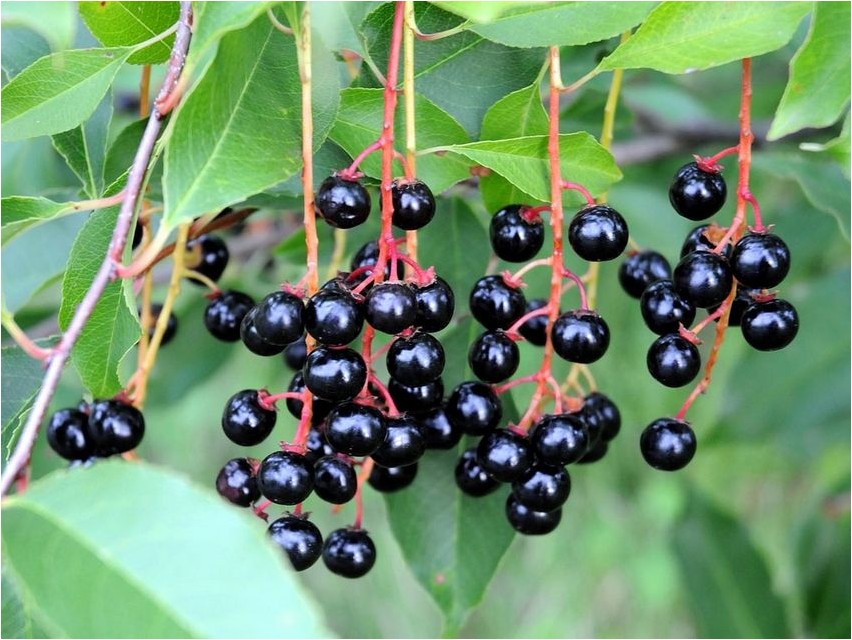
Bird cherry (lat. Prunus) is a berry crop; low trees, less often shrubs of the Plum genus of the Rosaceae family. In nature, bird cherry grows in bushes, forests, along river banks and forest clearings in Europe, Asia, North Africa and Transcaucasia.
Currently, bird cherry has naturalized throughout the temperate climate zone.
Characteristics of culture
Bird cherry is a tree or large shrub 0. 5-12 m high with an elongated and dense crown. The bark is black-gray, matte, with whitish lenticels over the entire surface. Young shoots are cherry-red or olive in color. The leaves are simple, glabrous, pointed, ovate-lanceolate or oblong-elliptical in shape, 3-15 cm long, sharply serrated at the edges, arranged alternately. Stipules are early falling, subulate. The petioles are short and have two glands at the base of the leaf blade.
The flowers are pink or white, collected in long and drooping racemose inflorescences 7-15 cm long, located on pedicels, have a strong aroma that flutters for several meters around. The fruit is a spherical drupe, reaches 8-10 mm in diameter, can be black or black-red in color, and has a sweet and strongly astringent taste. Flowering occurs in May-June. The fruits ripen in July-August.
Growing conditions

Bird cherry is an unpretentious crop; growing it is not at all difficult. Bird cherry is not demanding in terms of soil composition and lighting, but it develops best in areas with fertile, moderately moist soil with a neutral or slightly acidic pH reaction. To obtain good harvests of berries, two plants of different varieties are planted in the garden at once, blooming at the same time, since crop plants require cross-pollination.
Reproduction and planting
Bird cherry is propagated by seeds, root shoots, lignified and green cuttings and grafting. The seed method is time-consuming and ineffective; moreover, the properties of the mother plant are not fully preserved. Sowing is carried out in August — September under cover in the form of a thick layer of peat or sawdust. Young plants are transplanted to a permanent place after 1. 5-2 years.
Hobby gardeners most often propagate the plant by layering. The lower branches of the bird cherry, closest to the soil surface, are placed in pre-prepared furrows, pinned down, and covered with soil. As vertical shoots form, the layers are earthed up. In the fall, the rooted shoots are separated from the mother plant and planted in their permanent location. If the roots of the young plant are too weak, the layers are planted in nutritious and moist soil for further growth.
Seedlings purchased from specialized nurseries are planted in the fall or early spring. Planting holes are prepared a couple of weeks in advance; their size depends entirely on the root system of the seedlings, which must fit comfortably in the hole. A substrate consisting of fertile soil mixed with humus, sand, and complex mineral fertilizers is added to the bottom of the hole. Then, the seedling is lowered, the roots spread out, covered with soil, compacted, watered, and mulched. Peat or sawdust can be used as mulch. After planting, the seedlings are pruned to a height of 50-60 cm.
Care
Cherry tree care involves regular watering, loosening and digging the soil around the trunk, weed removal, foliar and root feeding, and sanitary and formative pruning.
The plants are trained as multi-stemmed shrubs or small trees with a tall trunk. To establish a low first tier of scaffold branches, the seedlings are pruned immediately after planting to a height of 50-60 cm. Of the emerging shoots, only the strongest and most developed, evenly oriented shoots are retained.
In subsequent years, the second and third tiers are formed in the same manner. With proper formative pruning, bird cherry trees will develop a beautiful, lush crown. Avoid allowing the crown to become too dense; remove any branches that cause crowding in early spring each year. Treat the cuts with garden pitch.