Bedstraw
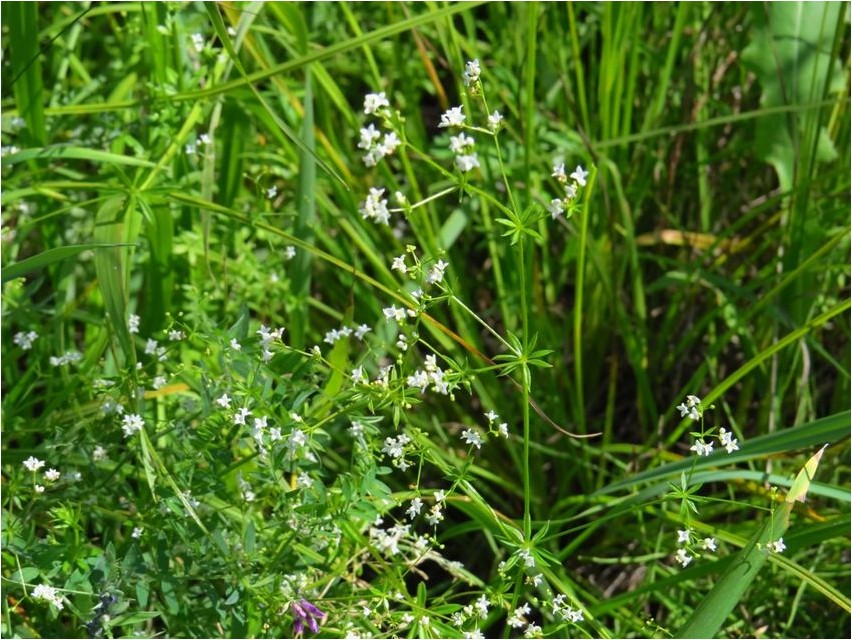
Bedstraw is a member of the bogbean family, the Latin name for this plant is Galium uliginosum L.
The Latin name for the bedstraw itself is Menyanthaceae Dumort.
Description of Bedstraw
Bedstraw is a perennial herbaceous plant, reaching heights between ten and seventy centimeters. Its stems are branched, weak, and spreading, with spines clinging to the ribs. The leaves of bedstraw are arranged in whorls of six, and can be either lanceolate or oblanceolate. They are approximately three to ten millimeters long and one to five millimeters wide. The bracts of the common bedstraw are paired, with the outermost leaves being solitary and very small, approximately one to two millimeters long and less than half a millimeter wide. The umbels of this plant are loose, six- to nine-flowered, and are located at the very ends of branches and stems. These umbels form a paniculate, spreading inflorescence. The corolla of the common bedstraw is white, approximately three to three and a half millimeters in diameter, with a short, wide tube and ovoid lobes. The fruits of the common bedstraw are one millimeter long and one and a half to two millimeters wide. These fruits are bifoliate, sometimes with one mericarp, while the other is underdeveloped. Marsh bedstraw blooms from July to August. In the wild, this plant is found in Belarus, Ukraine, the European and Siberian Arctic, the Caucasus, Central Asia, Western and Eastern Siberia, and the European part of Russia, with the exception of the Trans-Volga, Lower Volga, and Lower Don regions. This plant prefers lake and river banks, marshy meadows, ditch edges, crop fields, damp rocky slopes, lowland marshes, forest edges, shrub thickets, fallow fields, and swampy forests.
Description of the medicinal properties of Marsh bedstraw
Marsh bedstraw is endowed with very valuable healing properties, and it is recommended to use the roots and grass of this plant for medicinal purposes. The term grass includes leaves, flowers and stems. The presence of such valuable healing properties is recommended to be explained by the content of anthraquinones in the roots of this plant, while the herb of this plant will contain rutin, flavonoids, isorutin, hyperoside and astragalin.
As for traditional medicine, here this plant is quite widespread. Here it is recommended to use an infusion prepared on the basis of the herb of Marsh’s Bedstraw for algodisminorrhea.
For epilepsy, it is recommended to use the following very effective remedy based on this plant: to prepare such a healing remedy, you will need to take one tablespoon of dry crushed herb of this plant per glass of water. It is recommended to boil the resulting healing mixture for about two to three minutes, after which this mixture should be left to infuse for at least one hour, and then it is very important to strain this remedy thoroughly. Take the resulting medicinal remedy based on marsh bedstraw three to four times a day, two tablespoons.

Bedstraw Galium aparine Kiryat-Yam. Israel. Kiryat-Yam. Israel
Marsh bedstraw





