Lycania duck-like
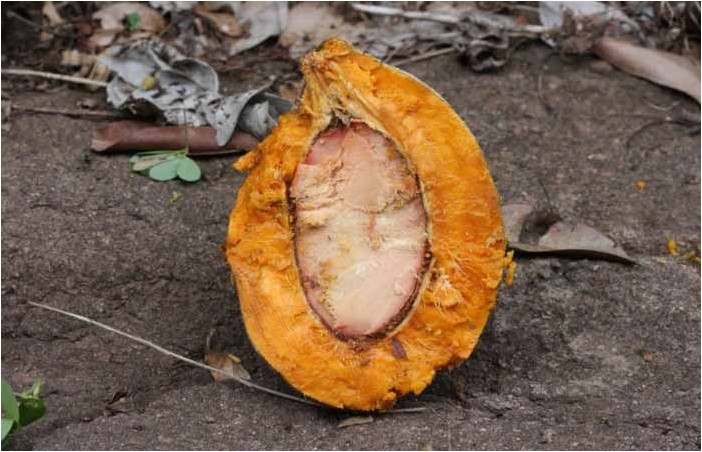
Licania platypus is a rare fruit crop from the Chrysobalanaceae family.
Description
Plants from the genus Lycania are low trees or shrubs. As for duckweed, it is a fairly rare tropical tree, endowed with thick branches, a rounded crown and dark purple or brown bark. And its height often reaches fifteen meters.
The simple leaves of the duck-shaped lycaea, pointed at the tips, are located oppositely on the branches. Their width almost never exceeds two and a half centimeters, and their length can vary from five to ten centimeters. It is noteworthy that young foliage is characterized by an incredibly attractive pink color.
Small yellowish flowers of the duck-shaped lycaea are collected in fancy brushes, the length of which can reach up to ten centimeters. And sometimes the flowers form funny triangular-like shields. You can admire the magnificent flowering of the duck-shaped lycaea from July to September.
Unlike other varieties of lycania, duck-shaped lycania has fairly large orange-white fruits, the length of which ranges from three to fifteen centimeters (for comparison, it is worth noting that the length of the fruits of other types of lycania rarely exceeds two to three centimeters). Moreover, they all have a very specific shape — obovate or pear-shaped. The taste of the fruit is quite sweet and somewhat similar to pumpkin, and they ripen in nine to twelve months.
Where does it grow
Lycanias are very widespread in South and Central America — their luxurious thickets appear with lightning speed in places of fresh felling. Panama and Southern Mexico are considered to be the birthplace of the duck-like lily.

Likaniya fruits can often be seen in local markets, but they have not yet received proper distribution throughout the world. And in Hawaii and the Philippines, this crop is generally grown to decorate parks, alleys and gardens.
Application
The fruits of duckweed are very good fresh — their energy value is 116 kcal for every 100 g. And the seeds extracted from them are an excellent raw material for obtaining oil. As for the chemical composition of these fruits, at the moment it has not been fully studied.
The duckweed licania is an excellent remedy for a wide variety of colds and cardiovascular ailments, as well as vitamin deficiencies and strenuous physical activity—it has a powerful immune-boosting and tonic effect. These pleasing fruits are rich in thiamine, calcium, riboflavin, iron, carotene, phosphorus, as well as ascorbic and nicotinic acids.
However, despite all their benefits, these fruits are not at all popular among local residents, who believe that consuming licania can lead to fever or a host of other equally dangerous illnesses.
Incidentally, licania fruits are not only consumed by humans—they are often grown as food for various animals, including monkeys. Its wood is also prized, often used to make furniture, various hydraulic structures, as well as railroad ties and piles. Contraindications
Allergic reactions and individual intolerances cannot be ruled out when consuming the duckweed lycania.
Cultivation and Care
The duckweed lycania is exceptionally heat-loving—it quickly dies at temperatures below four to five degrees Celsius. This is why it can only grow in tropical climates, and it thrives best in sunny locations. In addition to warmth, the duckweed lycania also requires adequate humidity, which must be maintained throughout the year.
Duckweed lycania