Morison’s Bittersweet
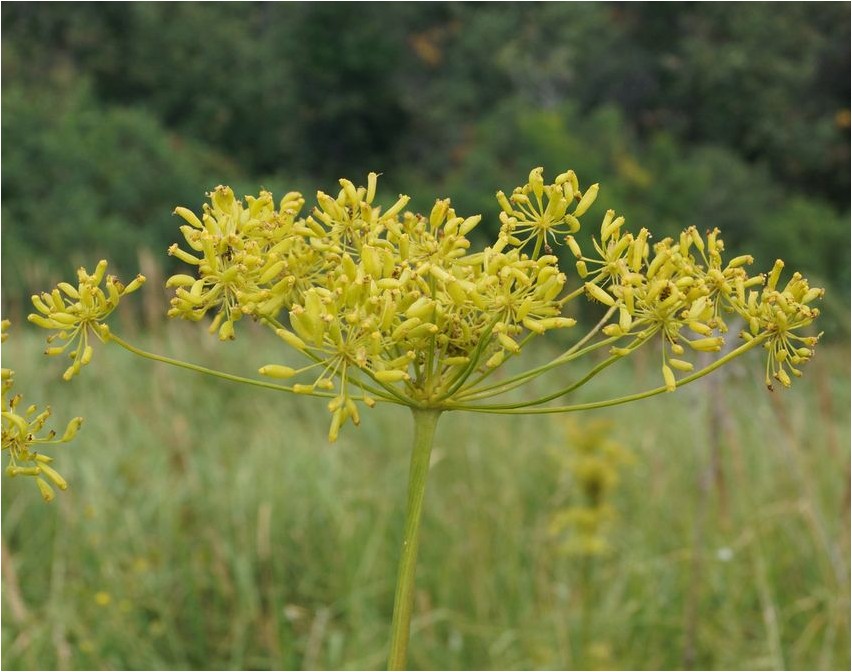
Morrison’s Bittersweet is a member of the Apiaceae family. Its Latin name is Peucedanum morisonii L.
The family name of Morison’s Bittersweet is Apiaceae Lindl.
Description of Morison’s Bittersweet
Morrison’s Bittersweet is a perennial herbaceous plant with a rather massive rhizome. This rhizome is approximately seven to ten centimeters thick and sixty to one hundred twenty centimeters tall. Young plants will have a taproot, while perennials will have a rhizome-like root, with the upper portion of the root bearing rhizome-like outgrowths. These outgrowths will bear growth buds, while the lower portion of the taproot is slightly branched. The root rind of this plant is tuberculate and warty, brownish-black in color, and flaky when dried. The pith of the rind is greenish-yellow, and resinous sap exudes from both fractures and cuts. The stem of the Morison’s knotweed is furrowed and sparsely foliated, branching at the top and bearing the remnants of dead leaves at the base. The leaves of Morison’s knotweed are multiply ternate, their blades triangular, and the terminal lobes lanceolate-linear, nine centimeters long and about four millimeters wide, with only one vein. The basal leaves of this plant form a rather dense, drooping rosette, reaching a height of about twenty-five to forty centimeters. Towards the very top of the stem, the leaves of this plant begin to shrink, and the uppermost leaves are reduced to sheaths. The inflorescences of the Morison’s knotweed are collected in numerous umbels, which are equipped with quickly falling linear involucral leaflets. The involucral leaflets consist of approximately five to thirteen petals, the flowers are quite sticky with short awl-shaped teeth, and the calyxes of this plant have five petals colored in yellow-greenish tones.
In the wild, Morison’s knotweed can be found throughout Western Siberia, as well as in Central Asia. This plant prefers steppe meadows, steppe shrub thickets, forb steppes, chernozem, fescue-feather grass, and feather grass-forb steppes.
Description of the medicinal properties of Morison’s gorychnik
For medicinal purposes, it is recommended to use the roots of Morison’s horn. The presence of such valuable healing properties is explained by the content of sucrose and the following coumarins in the roots: imperatorin, peucedin, peucedanin, bergaptol, peucenol and isoemperatorin. The aerial part of this plant contains coumarin imperatorin, as well as the following flavonoids: 3-rutinoside isorhamnetin, rutin, kaempferol, quercetin and isorhamnetin. The leaves of Morison’s cucumber contain peucedanin, and the inflorescences contain isorhamnetin and quercetin, while the flowers contain quercetin 3-rutinoside, isorhamnetin glycosides, quercetin, kaempferol and isorhamnetin. It is noteworthy that the fruits of Morison’s horn contain coumarins and essential oil, as well as the following flavonoids: quercetin, isorhamnetin, kaempferol, isorhamnetin glycosides and quercetin 3-rutinoside.
As for traditional medicine, a decoction prepared from the roots of this plant is used for diseases of the gastrointestinal tract, as well as for osteoalgia. It is noteworthy that the root extract of this plant is endowed with protisticidal, antibacterial and fungicidal properties.