Abronia
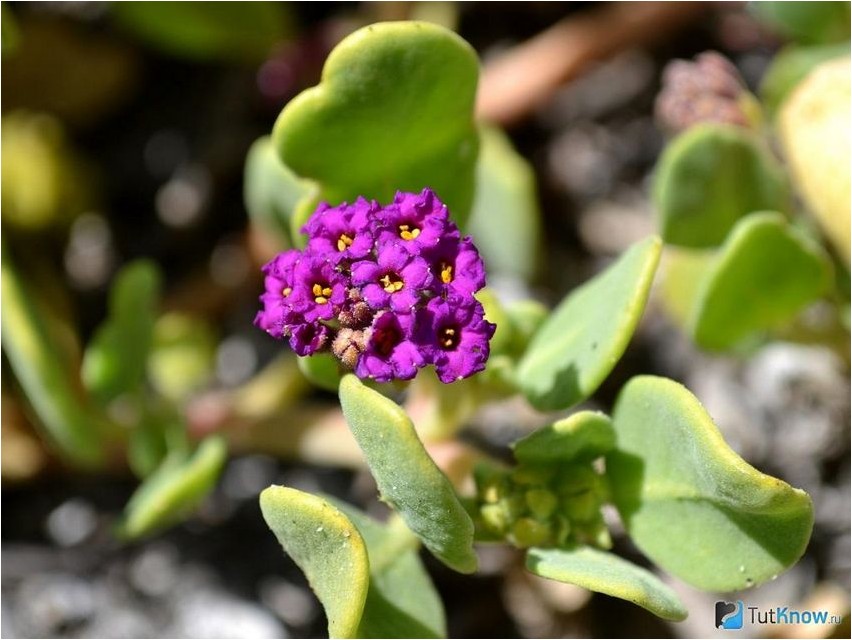
Abronia (lat. Abronia) are annual and perennial herbaceous plants or subshrubs of the Nyctaginaceae family.
The genus includes about 35 species, growing primarily in the subtropical regions of North America. Abronia was introduced into cultivation in 1788. The name of the plant comes from the word “abros”, which translates as joyful, graceful, cheerful.
Characteristics of culture
Abronia is an annual, less often perennial, semi-shrub plant up to 35 cm high with forked-branched shoots adjacent to the soil, completely covered with small fragrant flowers. The leaves are oblong-oval or lanceolate, tapering towards the base; there are species with heart-shaped leaves. The flowers are collected in umbrella inflorescences, distinguished by their special grace and beauty. The diameter of the inflorescences reaches 6-12 cm; in appearance they are similar to the inflorescences of verbena. Abronia blooms in mid-summer, flowering lasts until frost. The fruits are small, the seeds are appropriate.
Amateur gardeners have a special love for the species Abronia umbellate. The species is represented by perennial herbaceous plants up to 20 cm high. The stems are creeping, up to 50-70 cm long. The flowers are very small and fragrant. Petals fused at the base into a greenish tube. The flowers are collected in umbrella inflorescences, reaching 10 cm in diameter. Flowering is long-lasting, occurring in late June — early July.
An equally striking representative of the genus is broad-leaved Abronia (lat. Abronia latifolia). The species is represented by annual herbaceous plants up to 30 cm high. The stems are creeping, bending even at right angles, up to 50 cm long. The flowers are fragrant, small, rich yellow. Abronia broadleaf blooms from late May to August.
Growing conditions

Abronia is an unpretentious plant, but feels better in open sunny areas. In partial shade and shade, plants develop very slowly, flowering is later and short. Abronia tolerates all types of soil, but blooms more profusely on light, sandy, fertilized, moderately moist soils. The optimal air temperature is 25-30C. Abronia easily adapts to any external factors, especially in terms of resistance to drought.
Reproduction
Abronia reproduces by seeds. Sowing is done in seedling boxes or a warm greenhouse in March-April, or in open ground in May. Sowing before winter is not prohibited. Plants grown using the latter method bloom earlier and bloom much more abundantly than with spring sowing. With the emergence of seedlings, thinning or diving is carried out (depending on where the seeds were sown).
Application
Abronia is used to decorate various types of flower beds (beds, ridges, rockeries, rock gardens, etc.), group plantings, and patterned garden corners. The culture is ideal for borders. Often used as an hanging plant.
Care
Abronia is drought-resistant, capable of producing moisture on its own, but you should not give up rare watering and spraying. Fertilizing with mineral and organic fertilizers is also necessary; it is carried out in early spring or early summer, but before flowering.
It is fertilizers that provide plants with excellent potential for abundant flowering. From organic matter, it is preferable to use rotted manure, which will saturate the soil with nitrogen fertilizers. The crop is resistant to pests and diseases and is rarely affected by aphids. You can fight it by washing the leaves with soapy water.