Eryngium flatifolia
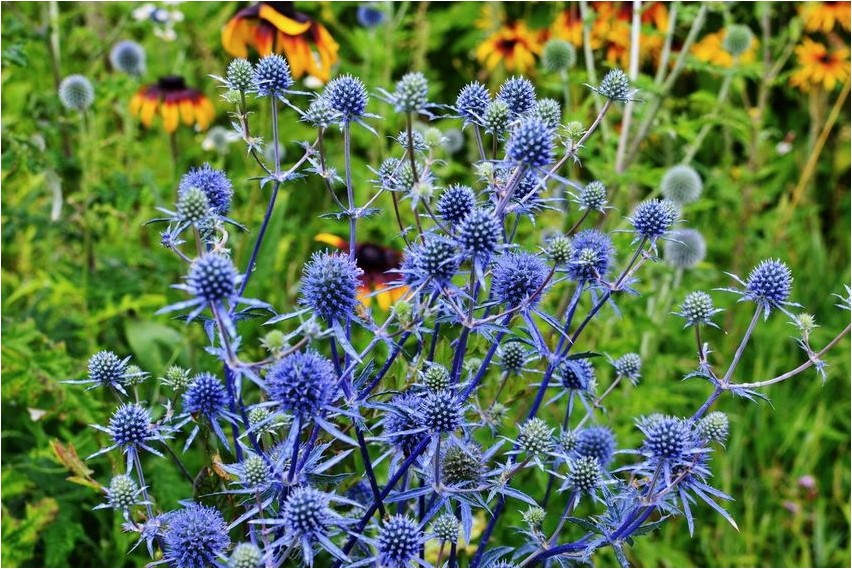
Eryngium planum L. is one of the plants of the family called Umbellaceae; in Latin the name of this plant will be as follows: Eryngium planum L.
As for the name of the flat-leaved eryngium family itself, in Latin it will be: Apiaceae Lindl. (Umbelliferae Juss.).
Description of Eryngium flatifolia
The flat-leaved eryngium is known by numerous popular names: bluehead, bluehead, thistle, thistle, thorn, bluebud, hare leaf, finger, centaury and pigwort. Bluehead flat-leaved is a perennial herbaceous plant, the above-ground parts of which are endowed with a blue-violet color. The root of this plant is quite thick, taprooted and white. The stem of Eryngium flatifolia is smooth, straight and branched at the top, and its length varies between forty and eighty centimeters. The leaves of this plant are green in color and leathery, the basal leaves are on long petioles, they will be oval and whole. At the same time, the upper leaves of Eryngium flatifolia are separate, sessile and endowed with serrated lobes.
The flowers of this plant are in the heads, the sepals are endowed with an awl-shaped point, and the petals will be oblong and blue in color, and the length of such petals is about two millimeters. The fruit of Eryngium flatifolia is an ovoid plant.
This plant blooms from June to July, while fruiting occurs in August. Under natural conditions, flat-leaved eryngium is found in Moldova, Western Siberia, Central Asia, the Carpathians, the Black Sea and Dnieper regions of Ukraine, Crimea, as well as the following regions of the European part of Russia: Volga-Kama, Zavolzhsky, Lower Volga, Black Sea, Upper Volga and Volga-Don regions. For growth, this plant prefers bushes, fallow lands, steppes, meadows, and the edges of deciduous and pine forests.
Description of the medicinal properties of Eryngium planum
Eryngium flatifolia is endowed with very valuable healing properties, and for medicinal purposes it is recommended to use the basal leaves, roots and grass of this plant. The term grass includes leaves, flowers and stems. The presence of such valuable healing properties should be explained by the content of saponins, sucrose, fructose, glucose, vitamin C, essential oil, flavonoids, phenolcarboxylic acids and their derivatives, chlorogenic and rosmarinic acids, as well as the following acids: malonic, oxalic, malic and citric. The fruits of this plant, in turn, contain fatty oil, carbohydrates, flavonoids and phenolcarboxylic acids.

In Western European countries, decoctions prepared from the roots of Eryngium flatifolia are used as a diuretic, expectorant and diaphoretic. In addition, such decoctions are used for various diseases of the bladder and whooping cough. An infusion based on the herb of this plant is used for epilepsy and liver diseases, and is also used as a diuretic. A decoction of the herb eryngium flatifolia is used for headaches, ascites, rheumatism, spasmophilia and kidney stones, and is also indicated for use as a sedative and expectorant. For itchy dermatoses in the Caucasus, Eryngium flatifolia is used as part of various infusions, and a decoction of the inflorescence is used for stomach colic in Kazakhstan.





