Rhododendron acuminate
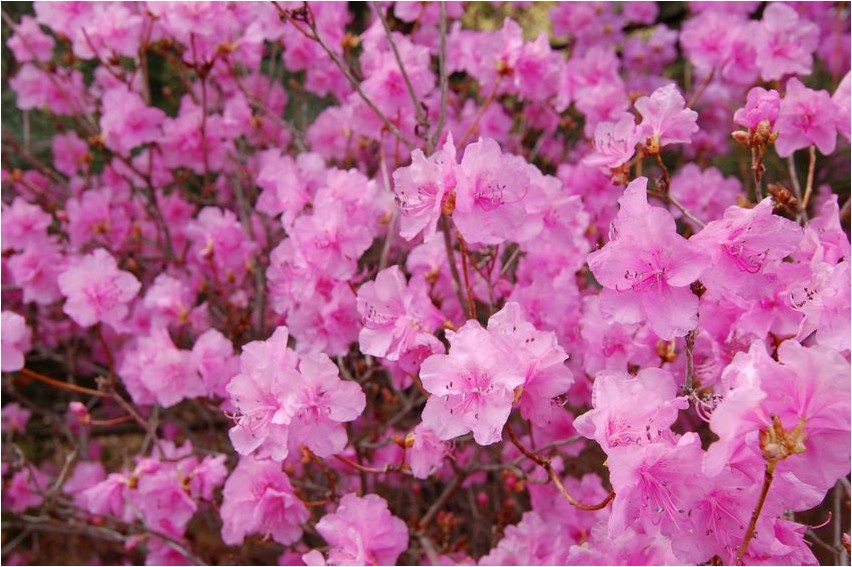
Rhododendron acuminate is one of the plants of the family called Ericaceae; in Latin the name of this plant will be as follows: Rhododendron mucronulatum Turcz.
As for the name of the rhododendron acuminate family itself, in Latin it will be: Ericaceae Juss.
Description of rhododendron acuminate
Rhododendron acuminate is a shrub whose height can reach three meters. Such a shrub will be endowed with gray bark, while the young shoots are straight and protruding, usually they are collected in several bunches at the very ends of the branches. Such shoots of this plant are painted in rusty-brown tones; they are covered with sessile round scale-like glands. The leaves of rhododendron acuminate will be bright green at the top, and bluish at the bottom. Such leaves are elliptical in shape, their length is three to eight centimeters, and their width does not exceed two and a half centimeters. It is noteworthy that this plant blooms without leaves, the corolla is light and can be colored in both purple-pink and white tones. Such a corolla of rhododendron acuminate is funnel-bell-shaped; up to the middle it will be cut into wavy lobes, which in turn overlap each other with their edges.
Rhododendron acuminate blooms from May to June, with fruiting occurring from July to August. Under natural conditions, this plant is found in the southwest of Primorye in the Far East. As for the general distribution of this plant, it is found in Korea, China, and Japan. For growth, rhododendron acuminate prefers dry slopes and mountain ridges, rocky areas, rocks, and undergrowth of coniferous-deciduous forests. It is noteworthy that the plant can grow either singly or in thickets.
Description of the medicinal properties of rhododendron acuminate
Rhododendron acuminate is endowed with very valuable healing properties, and it is recommended to use the flowers, stems and leaves of this plant for medicinal purposes. The presence of such valuable medicinal properties should be explained by the content of vitamin C, essential oil, flavonoids, coumarins, tannins, triterpenoids and the diterpenoid andromedotoxin in this plant.
In folk medicine, this plant is quite widespread. Traditional medicine recommends using an infusion and decoction made from the flowers of Rhododendron acuminate for various colds and headaches, as a tea.

It should be noted that this plant is also highly ornamental and is included on regional lists of endangered and rare species.
For various colds and headaches, the following highly effective remedy based on this plant is recommended: to prepare this remedy, take approximately one teaspoon of dried, crushed Rhododendron acuminate flowers per full glass of boiling water. The resulting medicinal mixture should first steep for two hours, after which it is recommended to strain it very thoroughly. Take this remedy based on Rhododendron acuminate three times daily, one-third to one-half of a glass. When used correctly, this healing remedy based on Rhododendron acuminate is very effective, and the positive effects will be noticeable quite quickly.





