Althaea officinalis
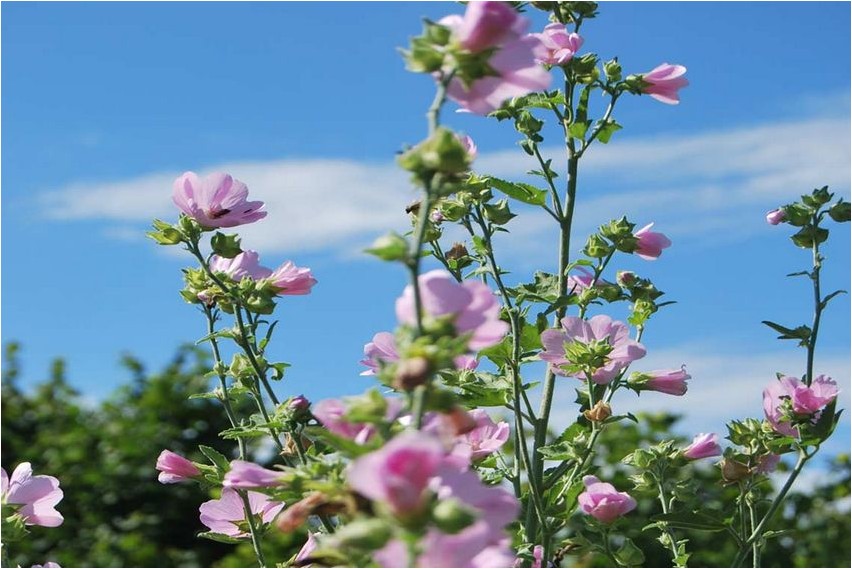
Althaea officinalis (lat. Althaea officinalis) is an unpretentious perennial herbaceous plant from the Malvaceae family, genus Althaea.
Since ancient times, people have recognized the healing abilities of this plant and continue their friendship with it to this day.
What’s in your name
Although the official names of plants are written in Latin, they are often based on Greek words. Thus, the word “althea,” which does not carry any semantic image in our language, suddenly becomes very understandable when you learn that in Greek it means “to heal.” It is difficult to think of a better name for a medicinal plant.
The name dates back to the times called “BC”. This is the name given to the plant by one of the founders of the science of botany, Theophrastus, who lived on Earth in the 4th century BC.
In addition, the plant has many popular names, in which people refer to its different parts. For example, looking at the cute fruits, people call Althea “kalachiki”; and the flowers, reminiscent of rose flowers in their shape, give rise to the name “wild rose”.
Description
The underground part of the plant is represented by a powerful taproot, going deep and reinforced horizontally by lateral fleshy roots, and a multi-headed rhizome, the short length of which is compensated by its thickness.

Such a strong base brings to the surface of the earth strong, one-and-a-half meter, erect, numerous stems, which are often simple, but can grow several lateral branches. They are protected from the vicissitudes of the climate by a thick covering of hairs, which makes them different from the stems of Mallow.
Matching the stems are large, velvety-felt leaves with pubescence, up to 15 cm long, alternately located along the stem and holding on to it with petioles. The round, ovate-heart-shaped leaves are divided into 3 or 5 lobes and have an irregularly serrated edge. When the plant begins to bloom and bear fruit, the leaves wither.
The flowers are similar to Mallow flowers, but smaller in size and paler in color. They can collect 2-3 flowers (less often), or form multi-flowered racemose inflorescences in the axils of the leaves, thus forming a common apical spike-shaped inflorescence. Flowering occurs in the second year of the plant’s life, like Mallow.
The fruit is a disc-shaped fractional polysperm, reminiscent of “cheese” to some, and “bread roll” to others. The fruits of the plant were not without hairs. Having matured, the polyspermia breaks up into fruitlets, each containing one smooth seed.
Healing abilities
The healing abilities of Althea officinalis are explained by the rich content of substances beneficial to the human body.
The roots of the plant consist of a third of starch, a third of mucous substances, followed by pectin, carotene, sugars, mineral salts, fatty oils and amino acids essential for the human body.
The leaves do not lag behind the roots, accumulating essential oil, carotene, ascorbic acid, and mucus.
Seed oil contains a number of important acids.
It is important for gardeners to know that Althea officinalis ash is rich in phosphates, which plants need for timely flowering and ripening. In addition, phosphorus helps plants better tolerate drought and frost.
Althaea officinalis is used in both folk and official medicine. Anyone who has children is familiar with a medicine called “mucaltin”, which helps alleviate cold coughs. These are small grass-colored tablets with a low pharmacy price, the main component of which is the roots of Althea officinalis.
Althea roots, which have the ability to envelop a sore spot, help not only with respiratory diseases, but also with stomach ulcers and various intestinal diseases, and with throat diseases.





