Small burdock
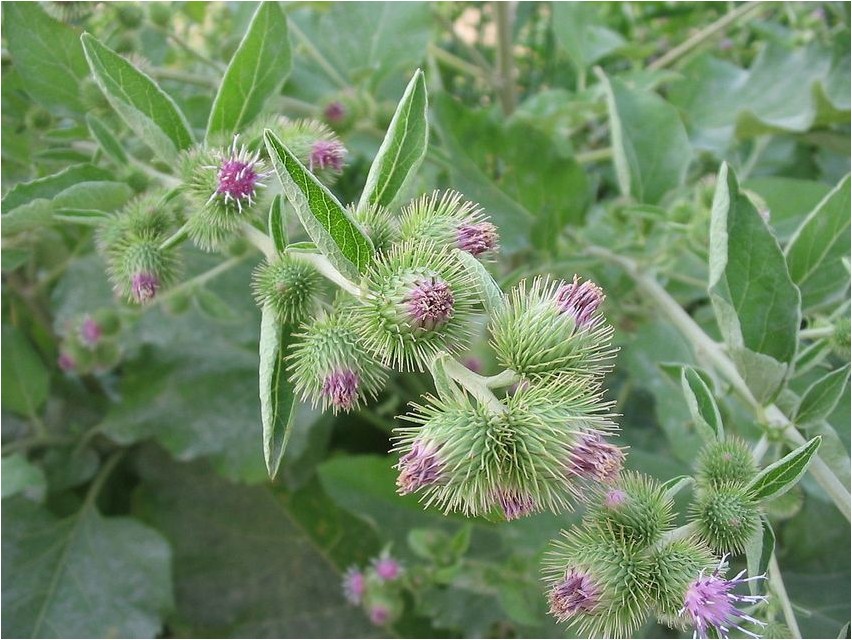
Small burdock is one of the plants of the family called Asteraceae or Asteraceae; in Latin the name of this plant will be as follows: Arctium minus (Hill) Bernh.
As for the name of the small burdock family itself, in Latin it will be like this: Asteraceae Dumort.
Description of small burdock
Small burdock is a biennial herbaceous plant, the height of which will fluctuate between fifty and one hundred and fifty centimeters. The root of this plant is thick and fusiform, as well as fleshy. The stem of the small burdock is erect, more or less powerful, it is covered with cobwebby drooping and will be longitudinally furrowed, and in color it can be either reddish or greenish. The leaves of this plant will be broadly ovate and petiolate, while the lower leaves at the base are heart-shaped, they will also be entire-edged, on top such leaves are colored green, and below they will be gray-green, occasionally they may also be white-tomentose. The general inflorescence of small burdock is racemose, the apical baskets are collected in so-called balls of three to six pieces and they will be located on rather short peduncles. The leaves of the small burdock wrapper end in a hard hook; the corolla can be pinkish-red to purple in color. The length of the achenes is about four to five millimeters, and their width is almost two millimeters.
Small burdock blooms from July to September. Under natural conditions, this plant is found in the Crimea, Belarus, Ukraine with the exception of the Carpathians, as well as in all regions of the European part of Russia except the Lower Volga and Dvina-Pechora regions. For growth, this plant prefers places along roads, near housing, ditches, embankments, clearings, clearings, meadows and forest edges.
Description of the medicinal properties of small burdock
Small burdock is endowed with very valuable healing properties, and it is recommended to use the roots and leaves of this plant for medicinal purposes.
The presence of such valuable healing properties should be explained by the content of rubber, flavonoids, essential oil, polyacetylene compounds, ascorbic acid, protein, inulin, sitosterol and tannins in this plant. Small burdock seeds contain fatty oil, which contains palmitoleic, palmitic, myristic acids and other higher fatty acids.

A decoction prepared from the leaves of this plant is recommended for use against scrofula, liver diseases and malignant tumors. The juice of burdock leaves is recommended for use against dysentery. As for external use, the leaves of this plant are used as a very effective antitumor and wound-healing agent.
It should be noted that these leaves are edible as vegetables. As a vegetable plant, burdock is cultivated in China, the USA, Belgium and France. In Japan, this plant is grown not only in vegetable gardens, but also on many industrial plantations.
For constipation, vitamin deficiency, malignant neoplasms, gastritis and hepatitis, it is recommended to use the following remedy based on this plant: to prepare such a remedy, it is recommended to take one tablespoon of burdock leaves per glass of boiling water. The resulting healing mixture should be infused for two hours, and then this mixture is filtered very carefully. Take the resulting healing remedy four to six times a day after meals, two tablespoons.
Burdock root, burdock
https://www. youtube. com/watch? v=jxqJ5A41mOU





