Louiseania
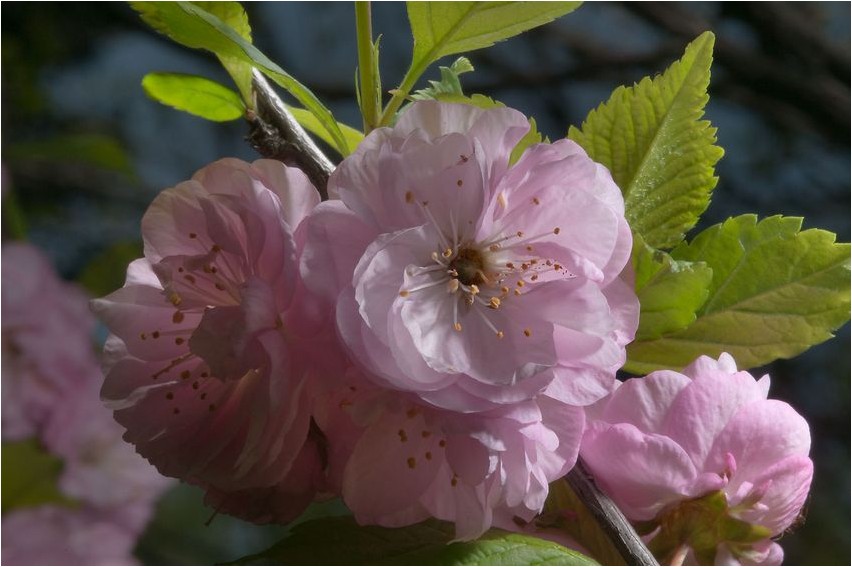
Louiseania (lat. Louiseania) is a light-loving woody plant from the Rosaceae family. The second name is three-lobed almond.
Description
Louiseania is a luxurious, beautifully flowering shrub up to three to four meters high, equipped with spectacular spreading crowns and funny protruding shoots, painted in dark gray tones. The attractive, vaguely three-lobed leaves, arranged in bunches on the fruiting shoots, have coarsely toothed edges. On the lower sides (if you unfold them), the leaves are initially densely hairy, and then, after some time, they become bare. As for the leaves growing on growth shoots, their edges are usually sharp-fine-toothed, and they all boast much more clearly defined medium-sized lobes.
During the flowering period, Louiseania is covered with a great variety of amazingly beautiful flowers, the color of which starts from light pinkish shades and ends with purple-red or crimson tones.
Where does it grow
Northern China is considered to be the birthplace of the beautiful Louiseania. And in natural conditions, these graceful shrubs can most often be found in Asia.
Usage
Louiseania looks great when planted in small groups, and it also combines beautifully with the rich green color of a wide variety of conifers. As for solitaire plantings, Louiseania will be perfectly combined with spring-blooming bulbous flowers such as daffodils, hyacinths and tulips.
It is quite acceptable to plant this beauty on lawns — for them it will become a magnificent decoration. Louiseania is also perfect for cutting — it will look very cool in all kinds of bouquets.

Growing and care
Since Louiseania is very light-loving, for planting it you should select areas that are well lit by the sun and reliably protected from piercing cold winds. This beauty is completely undemanding when it comes to soil, but it will still feel best on sandy, fertile loams. But good drainage is a must!
With the onset of spring, when Louiseania begins to bloom, it begins to be watered — shrubs growing on low-moisture sandy soils especially need watering. If there is not enough moisture for this beauty, it will fade very quickly. However, Louiseania also categorically cannot tolerate stagnation of moisture in the area, so it is extremely important to try to prevent it. In a word, this plant should be moistened moderately.
Louiseania boasts excellent frost resistance — it experiences much greater discomfort from late frosts, excessive dampness or thaws than from minus air temperatures.
Louiseania should also be planted in the spring. By the way, self-rooted seedlings almost always turn out to be less winter-hardy, therefore, in order to increase their winter hardiness, it is recommended to graft Louiseania cuttings into the crowns of plum trees. But this plant tolerates replanting very well!
Louiseania propagation usually occurs either by pre-stratified seeds or by vegetative means (grafting, prudently separated root shoots, small layering, as well as lignified or green cuttings).
Louiseania is more than resistant to various pests and diseases, especially with competent and proper agricultural practices. Plum sapwood bark beetles, as well as merciless plum moths and leaf rollers, attack these amazing shrubs extremely rarely; blue tits and aphids are much more capable of harming them. And among diseases, Louiseania can occasionally be affected by milky sheen and gray rot.





