Broad Bean
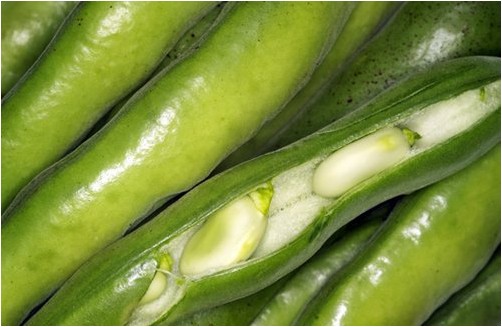
Broad bean (Latin: Vicia faba) is an annual plant of the legume family, belonging to the genus Vica.
History
For a thousand years before Christ, broad beans were widely cultivated in Palestine. They were also highly revered by the ancient Greeks and Egyptians (the latter even considered them sacred). The Mediterranean region is considered the birthplace of this crop. Currently, broad beans have earned a reputation as one of the most popular legumes.
Interestingly, Pythagoras, the great ancient Greek mathematician and philosopher, categorically advised against eating broad beans, claiming that they contained the souls of departed people. In some Western European countries, broad beans were an essential part of the great religious holiday of Epiphany—they were invariably included in the dough for the festive pie. Whoever gets a piece of the “surprise” pie becomes the “bean king” for the day.
Description
Faba bean is the proud owner of simple, upright, tetrahedral stems that can reach a height of one and a half meters. Each plant bears elliptical leaflets (one to three pairs). The taproots of this crop branch extensively at the ends and extend into the soil to a depth of 0. 8 to 1. 5 meters.
Like all other legumes, faba bean boasts intricate butterfly-shaped flowers. All of them are arranged in axillary racemes, pinkish or whitish in color, and have a faint, unobtrusive scent.
Faba bean fruits resemble seeded beans. All the seeds, enclosed in pods, are slightly flattened and oval in shape. Their color can be very diverse: black, purple, brownish, purple, red, white, and even spotted.

Where it grows
This crop is currently unavailable in the wild. However, it is cultivated in numerous southern European countries, as well as in the United States, India, and Africa. In Russia, fava beans are grown in almost every region (except perhaps the Far North).
Uses
Fava beans are used primarily as a food or forage crop. They are considered an excellent honey plant and are very rich in protein (up to 35%) and essential amino acids. They also boast high fat content (0. 8 to 1. 5%), carbohydrates (up to 55%), various enzymes, as well as valuable minerals and vitamins.
Since ancient times, fava bean has firmly settled in the kitchens of different peoples (Danes, Dutch, English, Bulgarians, Belgians, etc.) — it is used especially actively in cooking. But that’s not all — this plant is also highly valued in folk medicine, and absolutely any part of it can be used for medicinal purposes. The seeds of the fava bean have a diuretic, anti-inflammatory and astringent effect, and infusions and decoctions prepared from its leaves help alleviate the condition of those suffering from diabetes.
Beans ground into flour are used for severe coughs, as well as for various ailments of the gastrointestinal tract, kidneys and liver. However, mashed boiled beans help just as well. And beans boiled in milk are applied to abscesses and boils — this helps to significantly speed up their subsequent ripening.
Decoctions with infusions are also used — they are actively used for washing. They also wipe the face to relieve irritation and itching.
Contraindications
Horse bean is far from the best food for flatulence, constipation, gout and hepatitis. So, if you have any of the above conditions, it is better to refrain from using it.