Sweet Granadilla
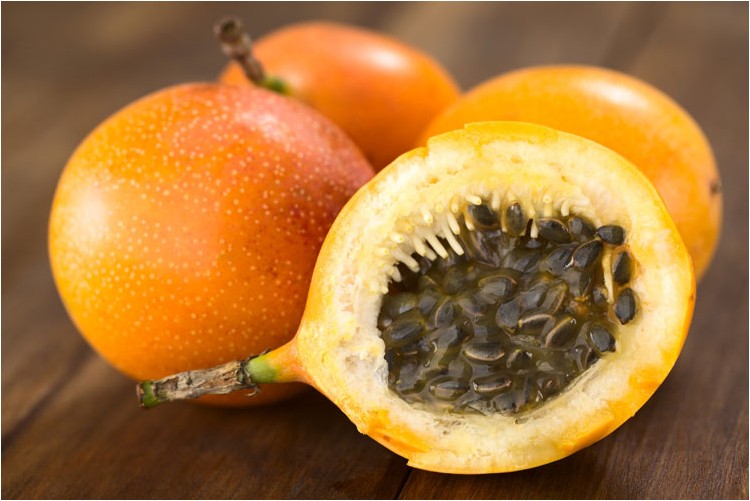
Sweet granadilla (Latin: Passiflora ligularis) is a fruit plant belonging to the Passifloraceae family.
Description
Sweet granadilla is a graceful, woody, fast-growing vine with smooth, cylindrical shoots that can reach up to five millimeters in diameter. Incidentally, each shoot lengthens by approximately three to four meters each season.
The oval, smooth-edged, and slightly heart-shaped leaves of sweet granadilla grow from seven to fifteen centimeters in length. All leaf petioles are equipped with specialized glands: one in the middle and one near the tip.
The flowers of this plant are as large as those of other passionflowers, ranging from five to ten centimeters in diameter. All the flowers are very unusual and strikingly beautiful, pinkish or white—this crop can be grown for its flowers alone.
The ovoid fruits of the sweet granadilla reach six to seven centimeters in diameter and boast a rather hard and slippery skin. They can be yellow, red, or orange.
Inside each fruit, you”ll find tiny black seeds, surrounded by a rather interesting translucent pulp, very reminiscent of gelatin.

Where it grows
The sweet granadilla”s distribution is quite wide. It is most commonly found in a number of Central American countries (from Bolivia to colorful Central Mexico), but it is also widely cultivated in Jamaica, New Guinea, Guam, Haiti, and Hawaii.
Uses
This unusual fruit is a vital food source for many indigenous peoples. These fruits are most often eaten fresh or used to extract juice, which is an excellent ingredient for non-alcoholic soft drinks.
The fruit pulp is enriched with vitamins and valuable microelements, making it an excellent general tonic and an excellent aid in the treatment of anemia (this fruit contains a lot of iron). This crop is also beneficial for excessively heavy menstrual periods and during the recovery period after complex surgeries. Regular consumption significantly promotes the renewal and growth of both hair and bone tissue.
The high potassium content in these fruits makes it possible to recommend them for various cardiovascular ailments, especially if they are associated with increased blood pressure, severe tachycardia or edema. And there is even more vitamin C in these bright fruits than in oranges, which means that sweet granadilla is an indispensable assistant both in preventing all kinds of viral diseases and in getting rid of them.
This plant is also used in gardening — this wonderful vine is excellent for landscaping public gardens, as well as any gardens and parks.
Contraindications
Sometimes allergic reactions may occur to the fruits.
Growing and care
Sweet granadilla is incredibly light-loving, so it will grow best only in well-lit open areas. However, its growth will also continue in the shade, but this beauty will not please you with flowering in this case.
Despite the fact that sweet granadilla is not considered a drought-resistant crop, it does not tolerate waterlogging. But it is absolutely undemanding to soils. As for propagation, it occurs both vegetatively (by cuttings) and by seeds.
How to eat exotic fruits: sweet granadilla and prickly pear
https://www. youtube. com/watch? v=2GFXUM0tUyw