Salt marsh point
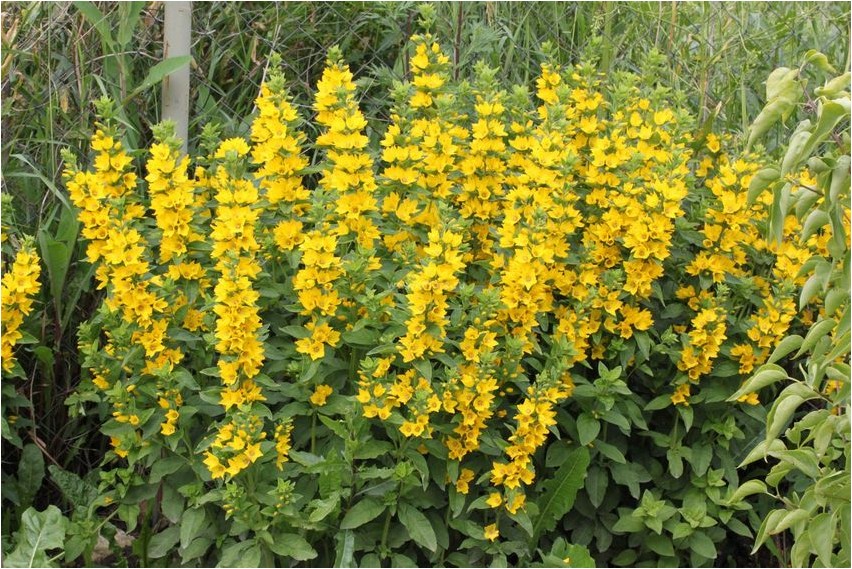
The saltwort is one of the plants of the family called Asteraceae or Asteraceae; in Latin the name of this plant will be as follows: Galatella punctata (Waldst. et Kit.) Nees (Aster punctatus Waldst. et Kit.).
As for the name of the saltwort family itself, in Latin it will be like this: Asteraceae Dumort. (Compositae Giseke).
Description of saltwort point
The point saltmarsh is a perennial herbaceous plant, the height of which will fluctuate between one hundred and twenty and one hundred and twenty-five centimeters. The stem of this plant is rough, its leaves can be either linear-lanceolate or linear. The length of such leaves will be about ten centimeters, the leaves will be sessile and they are endowed with three veins. The inflorescence of the saltwort is quite dense and corymbose in shape, the basket will be conical, and its length will be about seven to twelve millimeters. The involucre leaves of this plant are colored in greenish tones, they will be sharp, have a fringed edge, lanceolate or oblong in shape. False-ligulate flowers are painted in purple tones, there are only about five to ten of them, and the tubular flowers are pale yellow in color. The achenes of this plant will be hairy, their length reaches four and a half millimeters, while the pappus may be equal to the achene or be slightly longer than it.
The flowering of the saltwort occurs in summer and autumn. Under natural conditions, this plant is found in the Caucasus, Moldova, Central Asia, the Black Sea and Dnieper regions of Ukraine, as well as the Altai, Irtysh and Verkhnetobolsky regions of Western Siberia. For growth, the dotted salt marsh prefers steppe slopes, forests, clearings, places among bushes, floodplain and tall grass meadows up to the mid-mountain zone.
Description of the medicinal properties of saltwort
Salt grass is endowed with very valuable healing properties, and it is recommended to use the grass of this plant for medicinal purposes. The term grass includes flowers, stems and leaves. The presence of such valuable healing properties should be explained by the content of triterpene alkaloids and saponins in this plant.
In Siberia, saltwort is quite widely used for medicinal purposes: here an infusion prepared from the herb of this plant is indicated for use in myositis and various gastrointestinal diseases.

For colitis, gastritis and myositis, it is recommended to use the following very effective medicinal remedy based on this plant: to prepare this medicine, you will need to take three tablespoons of the herb, saltwort, per two full glasses of boiling water. The resulting medicinal mixture should first be left to infuse for about two hours, after which this mixture based on saltwort must be filtered very carefully. Take the resulting medicine based on saltwort three times a day before meals for all of the above diseases, one-third or one-fourth of a glass. It is important to note the fact that in order to achieve the greatest effectiveness when taking a medicine based on this plant, you will need to not only strictly follow all the standards for preparing this remedy based on saltwort, but also carefully follow all the rules for taking such a remedy. In this case, provided that it is used correctly, the positive effect will be noticeable quite quickly.





