Calopanax
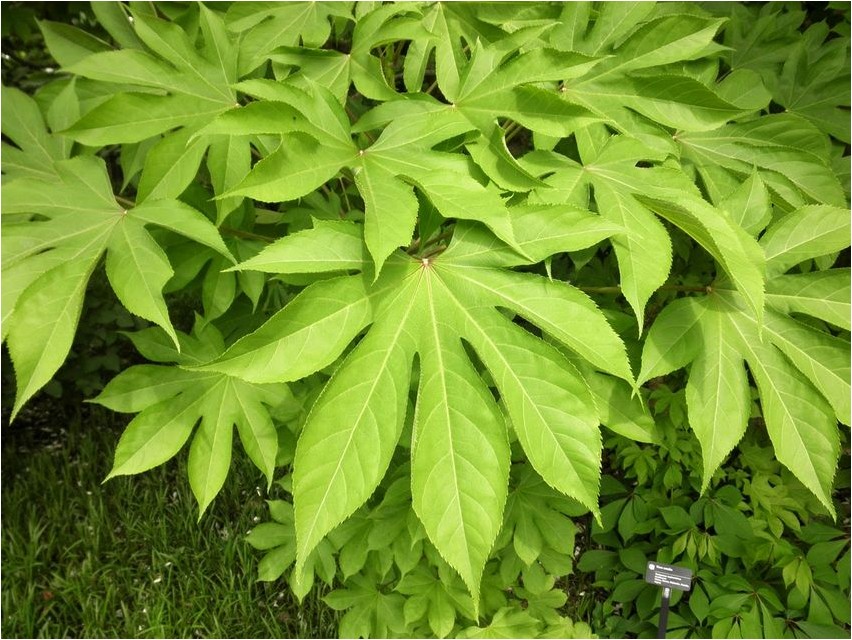
Kalopanax (lat. Kalopanax) is a genus of deciduous trees of the Araliaceae family. Another name is Dimorphant. It is found in nature on the Kuril Islands, Sakhalin, China, Japan and Korea.
Natural habitat: seashores, river valleys, mountain slopes and deciduous forests. Cultivated calopanax grow very slowly, often suffer from frosts and long dry periods, so they are rarely found on personal plots and in parks.
Characteristics of culture
Calopanax is a tree up to 25 m high with a straight, slightly branched trunk. The bark of young specimens is smooth, covered with large spines; The bark of adults is fissured and black in color. The leaves are long-petiolate, dark green, five or seven-lobed, up to 30 cm long. In autumn the foliage turns bright yellow.
The flowers are whitish-yellow, collected in large inflorescences formed at the ends of the shoots. Calopanax blooms in August, but not every year. Flowering depends on climatic conditions. The fruits are small, spherical, inedible, quite juicy, black, and contain two triangular seeds. The fruits ripen in September-October.
Reproduction
Kalapanax is propagated by seeds and cuttings. The seed method is ineffective because the seeds have low germination. As a rule, they sprout 1-2 years after sowing, and sometimes they don’t sprout at all. In addition, the seeds need preliminary stratification, which lasts about three months. Before planting seeds for stratification, the seeds are treated with sulfuric acid. Cuttings are also difficult; all attempts to propagate the crop using semi-lignified cuttings were unsuccessful. In nature, calopanax self-sows, due to this it continues to exist.
Care
Good care is important. Compliance with optimal conditions has a positive effect on the growth and development of calopanax and its winter hardiness. During prolonged drought, regular watering is necessary. Sprinkling is not prohibited.

It is advisable to mulch the soil in the tree trunk zone with wood chips or any other organic material. Mulching will prevent weeds from appearing and will retain moisture in the soil for a longer time. The crop also needs fertilizing; this measure promotes better ripening of shoots before the onset of persistent cold weather.
Application
Kalopanax is a highly ornamental plant that looks beautiful both in single and group plantings. Excellent companions include small-leaved hornbeam, Manchurian flax, single-leaved fir, and other ornamental shrubs and trees. Kalopanax is ideal for automnalia (autumn gardens).
The wood of these plants is strong, lightweight, and soft, with a beautiful golden hue and unusual grain, which is why it is widely used in carpentry. It is used to make parquet flooring, hunting rifle stocks, and other items. The leaves, roots, and bark of the plants contain a large number of biologically active substances, which is why these plant parts have found use in folk medicine.





