Banana granadilla
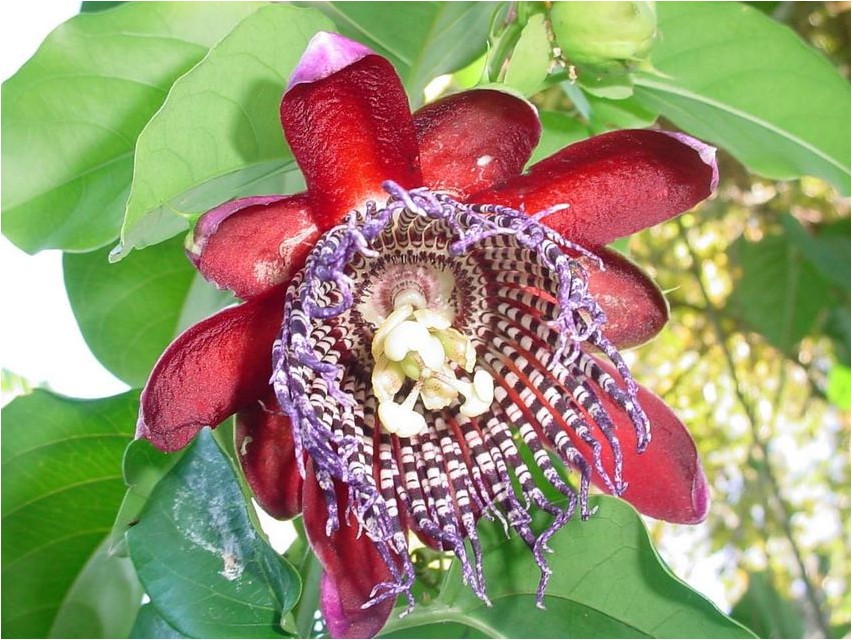
Banana granadilla (lat. Passiflora mollissima) is a tree-like vine belonging to the Passionflower family.
Description
Banana granadilla is a climbing plant, more precisely, a tree-like vine, the height of which can easily reach six meters. And the stems of this crop are densely covered with a pleasant yellowish fluff. However, not only the stems are covered with down, but also the trilobed leaves with graceful finely toothed edges.
Banana granadilla blooms with tubular flowers, colored in reddish-pinkish or grayish-greenish tones. It is noteworthy that these flowers do not smell at all.
The dark green or pale yellow fruits of banana granadilla contain dark orange pulp with a tart-sweet taste and a large number of small black seeds. The pulp smells very pleasant. And since the fruits contain up to 92% water, they are all very juicy and quite watery. As for their weight, it is very small and ranges from fifty to one hundred and fifty grams.
Banana granadilla boasts a truly impressive yield — up to forty-seven tons of fruit can be harvested from one hectare without much difficulty! Moreover, in its homeland it bears fruit almost throughout the year, but in New Zealand its fruits are harvested only from March to October.
Where does it grow
In the wild, banana granadilla can often be seen in South American countries such as Bolivia and Ecuador, as well as Venezuela, Peru and Colombia. They began to cultivate it there a long time ago, long before the Spanish conquest. And not so long ago, plantations of this crop appeared in India, as well as in New Zealand.

Application
Most often, the pulp of banana granadilla is consumed fresh; in addition, it makes excellent jams, rich juices and very tasty jellies and meringues. Residents of South American countries very willingly drink the juice of this fruit mixed with milk, and in some countries they make wonderful wine from it (by fermentation). Despite the fact that banana granadilla is very sweet, its calorie content is only 25 kcal. It also quenches thirst perfectly. To eat a fresh fruit, you need to cut it into two parts lengthwise and extract the pulp with a spoon. And you can safely throw away the peel.
Regular consumption of these exotic fruits helps improve sleep and reduce nervous excitability, and also has a very beneficial effect on the activity of the gastrointestinal tract. Banana granadilla is especially good for intestinal and stomach ulcers and increased acidity of gastric juice.
Contraindications
Those who suffer from hypotension are not recommended to consume banana granadilla in too large quantities. Also, its use can provoke allergic reactions. You should not eat this fruit in the first half of the day — it often leads to drowsiness.
Growing and care
At temperatures below minus two degrees or more than thirty degrees above zero, banana granadilla quickly dies. However, this plant also does not like an arid and hot climate — it will feel best in mountainous areas located at an altitude of up to 3200 meters above sea level. As for the optimal temperature for its growth, it ranges from fifteen to twenty degrees. Of course, fruits can ripen at temperatures of about ten degrees, but in this case this process will take much longer. In years with cold summers, this vine can grow in the south of Russia, however, the fruits in our latitudes will not have time to ripen in any case.
Banana granadilla is often used in indoor floriculture, because it is an excellent ornamental plant. It is only important not to forget that this plant is a vine and needs good support up to six meters high.





