Bail
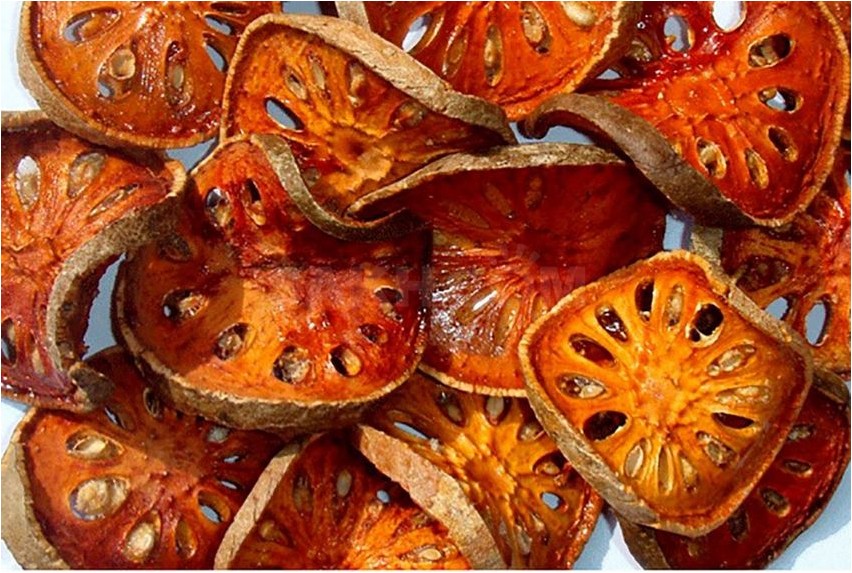
Bail (lat. Aegle marmelos) is a fruit tree from the Rutaceae family, also called Bengal quince or stone apple.
Description
Bail is a slow-growing fruit tree up to twelve to fifteen meters tall. Its fancy oval leaves reach a width of two to five centimeters and a length of four to ten centimeters.
The diameter of the oblong or rounded bail fruits averages from five to twenty centimeters. Each fruit is covered with a thin woody shell. In ripe fruits it is usually yellowish, and in unripe ones it is grayish-greenish. In addition to the central nucleolus, inside each fruit there are from eight to twenty triangular segments filled with slightly astringent, sweet, doughy and fragrant pale orange pulp and equipped with thin walls of dark orange shades. And the few bones of the bail are densely covered with hairs.
Where does it grow
Bail can be found growing wild in the forests of Bangladesh, Pakistan, Indochina, Sri Lanka and India. And as a cultivated plant, it is cultivated throughout the Philippines, Sri Lanka, Indonesia, Malaysia and India.
Application
Bail is very widely used for religious worship — both Buddhist and Shaivite. In Hindu-Buddhist literature it is well known as “Bilwa Fruit”. In Shaivism, bail leaves, sitting three on a petiole and thereby resembling Shiva’s trident, are sprinkled on the Shivalinga on the winter new moon holiday.
In Vajrayana Buddhism, bail fruits are an integral part of the “five sense offerings” (along with a silk scarf, a shell filled with incense water, cymbals and a mirror). In this cult, bail symbolizes taste. In addition, it is also included in the offering of the “eight auspicious emblems”, which represent the gifts offered to the bodhisattva Shakyamuni (along with cinnabar, durva grass, shell, mustard seeds, curd, healing elixir and a mirror).

Bail fruits also make excellent tea, which helps improve immunity and has a pronounced general strengthening effect. It is recommended to drink this tea for certain respiratory diseases (bronchitis, asthma, etc.). Tonsillitis, sinusitis and rhinitis — all can be treated with this miraculous drink. And dried fruits are great for colds.
By the way, bail that is just beginning to ripen is considered to be the most useful — in this form it helps renew the skin. These fruits are also an excellent laxative. If you systematically consume ripe fruits, they will help cleanse the intestines and remove accumulated toxins and waste from the body.
The mild astringent effect of the fancy bail fruits has a beneficial effect on the functioning of the entire digestive system. This fruit perfectly supplies the body with ascorbic acid and even helps improve appetite.
However, in folk medicine, not only the fruits of the bail are used, but also its leaves, trunks and bark. Healing decoctions and infusions are prepared from them, helping to cure many different ailments. And the powder from the dried fruits is used to treat dysentery and diarrhea.
In the places where bail grows, a wide variety of dishes are prepared from it. These fruits can be eaten separately or added to all kinds of desserts: sherbet, ice cream, jelly, etc. Bail also makes wonderful fruit salads. They also make excellent drinks from it, the most famous of which is sharbat.
Bail is also good because it has absolutely no contraindications — it is not recommended to eat it only for people with individual intolerance.