Pepino
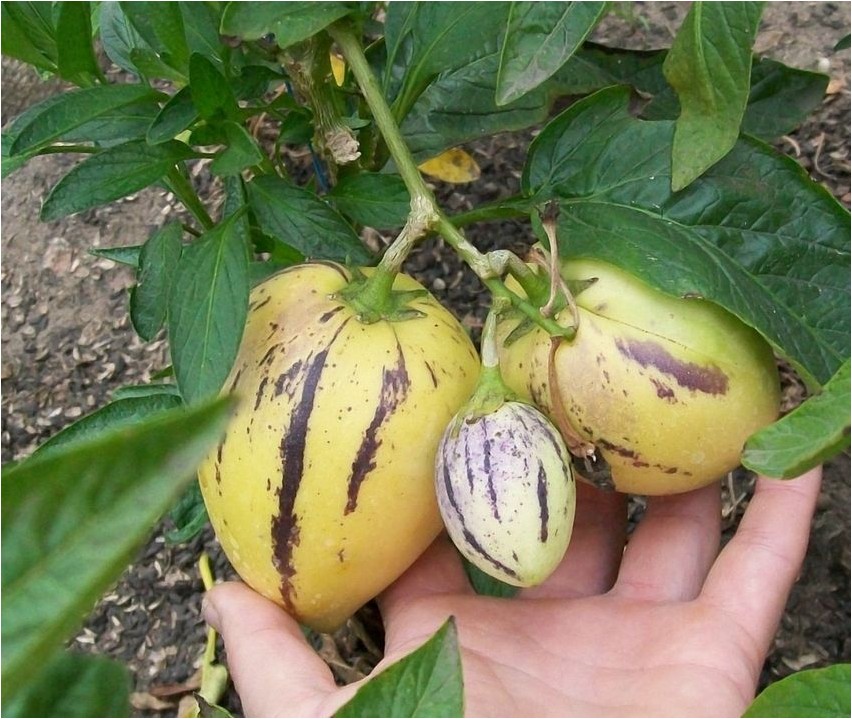
Pepino, Sweet cucumber or Melon pear (lat. Solanum muricatum) is an evergreen shrub of the Solanaceae family. South America is considered to be the homeland of pepino.
Today the plant is widely cultivated in Chile, New Zealand and Peru. In color and aroma, pepino fruits resemble cucumber, melon and pumpkin at the same time. In Russia, pepino is grown extremely rarely, mainly on personal plots in heated greenhouses and at home.
Characteristics of culture
Pepino, or melon pear, is a perennial plant, which is a highly branching, semi-lignified shrub up to 1. 5 m high. The root system is powerful, fibrous, thanks to which the plants tolerate replanting without problems, the roots are restored and continue to actively develop. The stems of pepino are thin, without being tied to a support they lie on the ground and subsequently take root. With increased air and soil humidity, plants are able to form aerial roots. The leaves are dark green, entire, with a wavy surface.
The flowers are lilac, light purple, white or white with bluish stripes, collected in racemes of 10-20 pieces. The fruit is a berry, can be oblong, obverse pear-shaped, flat-round or flattened, weighing up to 750 g. Ripe fruits are creamy yellow, yellow or yellow-orange with or without lilac specks and stripes. The skin of the fruit is smooth, very strong, shiny, and easily separated from the pulp. The pulp is juicy, aromatic, tender, and has a sweet taste. Under favorable growing conditions, the fruits have the taste and smell of melon; under unfavorable conditions, the fruits have the taste and smell of cucumber.
Growing conditions

Pepino is a heat-loving plant that grows well in regions with a moderately warm climate. The melon pear does not tolerate heat. Temperatures above 30C have a negative effect on plant growth, and low temperatures have a detrimental effect on young ovaries. The optimal air temperature is 20-25C. Even minor frosts affect leaves, flowers and young ovaries, but fruits and lignified stems can withstand short-term frosts down t o-3C.
Pepino is a day-neutral plant, since normal fruit formation is observed both with short and long days. The culture prefers well-moistened, drained, neutral soils with a deep arable layer. Soils with a high nitrogen content are not suitable, as plants build up excess vegetative mass to the detriment of fruits. The culture does not accept saline, acidic and waterlogged soils; pepino is affected by rots of various types on them.
Reproduction and planting
Pepino is propagated by seeds and suckers. Seeds are sown in seedling boxes at the end of January. It is important to provide the seedlings with proper care and additional lighting. In this case, the first fruits will delight their owners in early July. The optimal germination temperature is 28C. With the emergence of seedlings, the temperature is reduced to 18C and then increased by 5C. Seedlings grow very slowly and practically do not stretch. Planting of seedlings is carried out in the phase of 2-3 true leaves. The seedlings are buried down to the cotyledons.
Reproduction of pepino by stepsons is also a fairly effective way. You can collect stepsons from seedlings that are one month old. The stepsons are rooted in seedling boxes, after which they are transplanted into separate pots and grown for 45 days, and only then transplanted to a permanent place. By the way, pepino gives 100% rooting, and without the use of growth stimulants. It should be noted that stepsons take root best in peat without shading, the first roots appear after 3-4 days, mass rooting occurs after 10-12 days.
Care
In general, caring for a melon pear is similar to caring for tomatoes. It consists of regular watering, weeding and fertilizing. The soil in the near-stem zone should not be allowed to become waterlogged, otherwise this may lead to rotting of the roots. A couple of weeks after planting the seedlings in the ground, the plants are tied to a support and begin to form. Pepino is formed into 2-3 stems, systematically removing the stepsons. Overgrown stepsons are cut off with pruning shears. Fertilizing with mineral fertilizers is also not prohibited.