Lesser Rattle
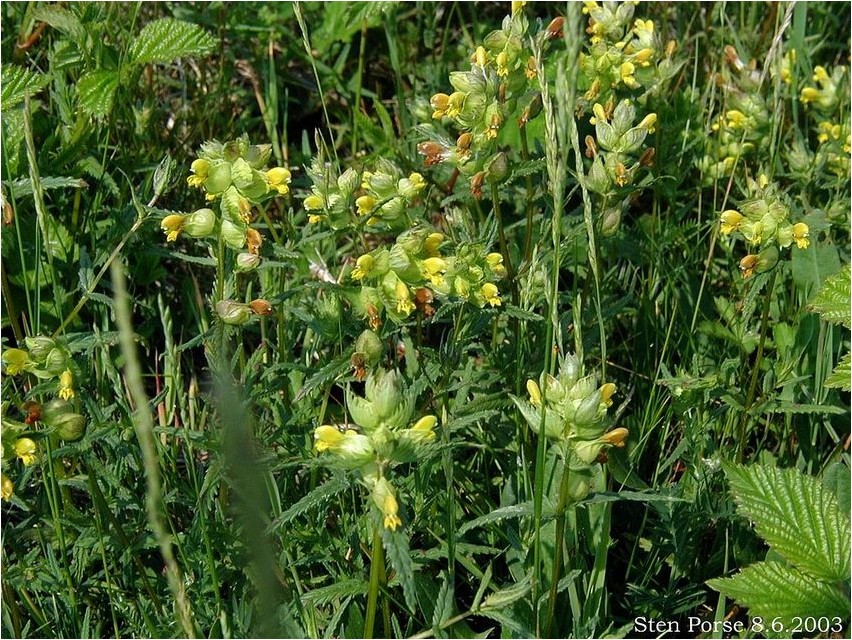
The Lesser Rattle is a member of the Scrophulariaceae family. Its Latin name is Rhinanthus minor L.
As for the family name itself, the Latin name is Scrophulariaceae Juss.
Description of the Lesser Rattle
The Lesser Rattle is an annual herbaceous plant, reaching a height of between twenty and fifty centimeters. It is noteworthy that this plant is also a parasite. The stem of the Lesser Rattle has four to nine elongated internodes and is glabrous or sparsely hairy. The leaves of this plant can be either oblong-lanceolate or lanceolate, measuring two to four centimeters in length and five to ten millimeters in width. The corolla of this plant is yellow, approximately twelve to fifteen millimeters long, with a straight, shorter calyx. The upper lip is rounded and small, and can be light or purple. The lower lip of the lesser rattle is prominent, with the corolla opening open. The capsule itself is rounded, approximately nine to ten millimeters in diameter, and the seeds are three to four millimeters long and winged.
The lesser rattle blooms from May to June, while in the northern part of its range, flowering does not begin until August. In the wild, this plant is found in the Caucasus, the Far East, Western Siberia, Ukraine, and the European part of Russia, with the exception of the Lower Volga region. The common rattle prefers the banks of rivers, lakes, and seas, forest edges, and meadows. In the Caucasus, this plant grows at altitudes of up to three thousand meters above sea level. It’s worth noting that the common rattle is a poisonous plant, an insecticide, and a highly valuable honey plant.
Description of the medicinal properties of the common rattle
The common rattle has highly valuable medicinal properties, and its herb is recommended for medicinal purposes.
The presence of such valuable medicinal properties is believed to be explained by the plant’s content of phenolic acids, flavonoids, carotenoids, chlorogenic acid, phenolic acid and its derivatives, benzoic acid, steroids, alkaloids, iridoids, carbohydrates, and related compounds: sucrose, mannitol, pectin, and mannitol. It should be noted that the medicinal properties of the lesser rattle are similar to those of the greater rattle.

It is noteworthy that in Siberia, a decoction made from the lesser rattle is recommended for fever, headaches, and arrhythmia. This plant is used as a poultice and compress for sore throats. An infusion based on this plant should be used for venereal diseases and boils. It is also worth noting that the seeds of the lesser rattle are a very valuable source of purple dye. However, it is important to remember that this plant is poisonous and should therefore only be used under the close supervision of a physician.
For fever, arrhythmia, and headaches, use the following remedy based on this plant: to prepare this remedy, take one tablespoon of crushed common rattle herb and add two cups of boiling water. Let this mixture steep for approximately two hours and then strain thoroughly.
Dialogue with a Lost Dog!





