True bedstraw
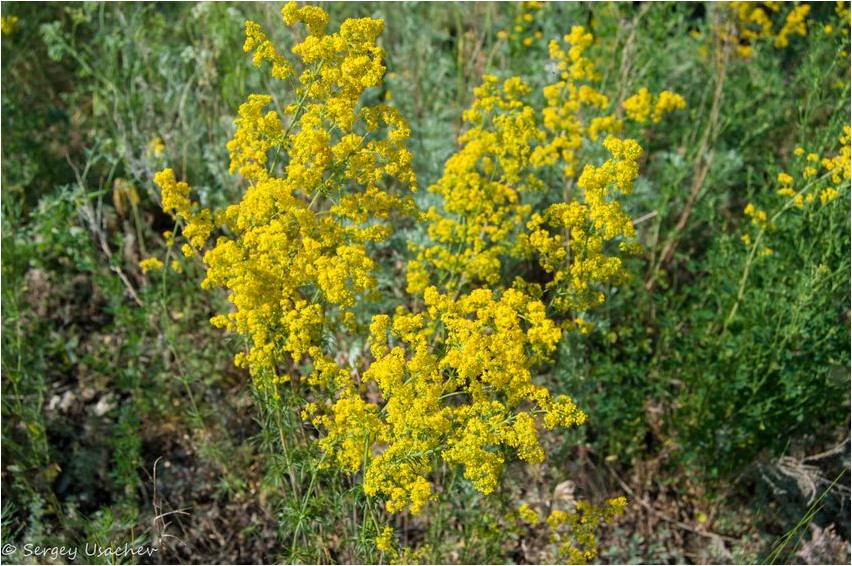
The true bedstraw is one of the plants of the family called Chenopoaceae; in Latin the name of this plant will be as follows: Galium verum L.
As for the name of the bedstraw family itself, in Latin it will be: Rubiaceae Juss.
Description of the bedstraw
The true bedstraw is known by the popular names honey grass, breast grass, yellow butterwort, cutting grass, pine, carrot grass, pinworm, small wormwood, cherry grass, common grass, and whey. Bedstraw is a perennial herbaceous plant, endowed with a branched rhizome and a rather thin tetrahedral ribbed and branched stem, the height of which will fluctuate between thirty and one hundred and twenty centimeters. The leaves of the bedstraw are sharp and narrow-linear, they are arranged in whorls of about eight to twelve pieces, they are pointed and colored in dark green tones. The flowers of this plant will be quite small in size, they are painted in bright yellow tones and are collected in a rather dense spreading panicle, endowed with a delicate honey aroma. The corolla of the true bedstraw is commissural-petallal and four-parted; there are only four stamens, while there is only one pistil.
Bedstraw blooms during the period from the second half of July to September. It is noteworthy that this plant is also a very valuable honey plant. Under natural conditions, the plant is found in Western and Eastern Siberia, the European part of Russia, the Caucasus, Central Asia, the Far East, Belarus and Ukraine. For growth, bedstraw prefers forest glades, steppes, dry meadows, shores of lakes and rivers, calcareous deposits, forest edges, clearings and steppe slopes.
Description of the medicinal properties of bedstraw
The true bedstraw is endowed with very valuable healing properties, and for medicinal purposes it is recommended to use the roots, inflorescences and grass of this plant. The term grass includes flowers, stems and leaves.
The presence of such valuable medicinal properties is attributed to the plant’s content of coumarins, tannins, essential oil, steroids, saponins, iridoids, coloring agents, as well as the following trace elements: manganese, copper, zinc, iron, nickel, titanium, chromium, and molybdenum. The flowers and leaves of this plant contain an enzyme that causes milk curdling. For this reason, these parts of the bedstraw plant are also used in cheesemaking.

In folk medicine, this plant is quite widespread. Preparations based on the bedstraw plant are recommended for use as hemostatic, choleretic, antiseptic, astringent, anti-inflammatory, sedative, and wound-healing agents. An infusion made from the herb and flowers of bedstraw is recommended for diarrhea, as a hemostatic and astringent, and is also used for hemorrhoids, gastritis, endometritis, nosebleeds, and menstruation. This remedy is also used as a diuretic for edema and urolithiasis, as a pain reliever for headaches, colic, and intestinal cramps, and as an anticonvulsant for epilepsy and infantile convulsions. As a sedative, this remedy based on bedstraw has found use in neurasthenia and hysteria. It should be noted that this remedy is very effective when used correctly.
Bedstraw.
https://www. youtube. com/watch? v=10o6wQxeCIA





