Cacalia spear-shaped
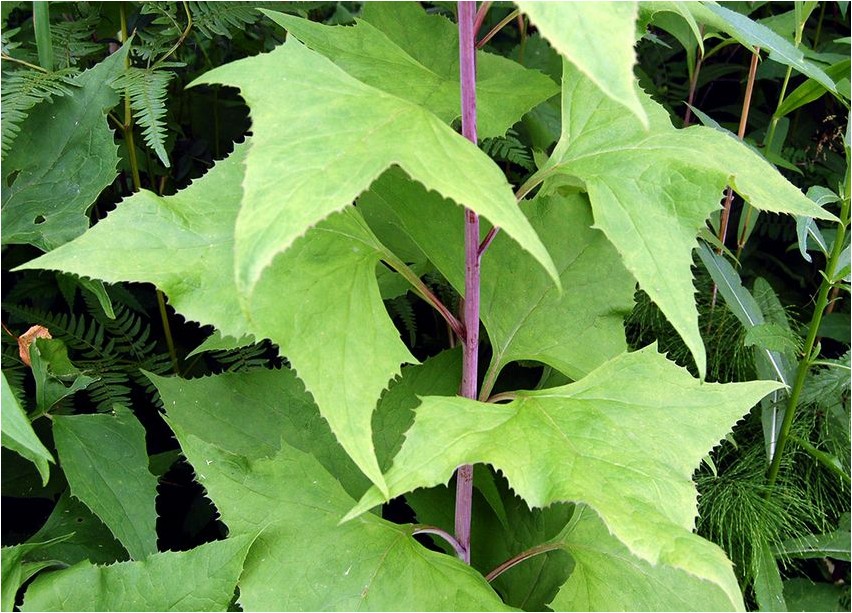
Cacalia spear-shaped is one of the plants of the family called Asteraceae or Asteraceae; in Latin the name of this plant will be as follows: Cacalia hastata L.
As for the name of the spear-shaped poop family itself, in Latin it will be: Asteraceae Dumort.
Description of spear-shaped poop
Lance-shaped cacalia is also known as spear-shaped underripe. Kakalia spear-shaped is a perennial rhizomatous herbaceous plant, endowed with a straight stem, the height of which will fluctuate between fifty and one hundred and fifty centimeters. The leaves of this plant are petiolate, broadly serrated and endowed with triangular serrated lobes. The uppermost leaves of this plant will be broadly lanceolate and short-petioled. The flowers of the spear-shaped cacaly are bisexual and quite large; they are colored yellowish-white and are collected in baskets at the very top of the stem into a paniculate inflorescence. The seeds of this plant are endowed with long flights.
Flowering of lance-shaped poop comes from June to August. It is noteworthy that this plant bears fruit in the month of August. Under natural conditions, this plant is found everywhere in Russia, Ukraine and Belarus. For growth, the plant prefers small-leaved and sparse forests, forest and riverine meadows, mountains along river valleys and is sometimes found in forests. It should be noted that in some places the plant rises up to the lower part of the alpine belt.
Description of the medicinal properties of poop poop
Kakalia spear-shaped is endowed with very valuable healing properties, and it is recommended to use the leaves and roots of this plant for medicinal purposes. The presence of such valuable healing properties is explained by the content of the alakaloid hastacin in the roots, leaves and rhizomes, which will be endowed with antispasmodic effects. There are also tannins of the pyrocatechol group present here; calcium tartaric acid and inulin are present in the roots and rhizomes of this plant. The aerial part of the kaka lanceata contains flavonoids, and fresh leaves will contain carotene and ascorbic acid.
In folk medicine, this plant is widely used. Kakaliya lanceolata is used to treat bronchitis, radiculitis, arthritis, various colds, and liver diseases, and is also used as a wound-healing, laxative, and hemostatic agent.

For bronchitis and urinary retention, the following highly effective remedy based on Kakaliya lanceolata is recommended: to prepare this remedy, take one tablespoon of crushed leaves of this plant per 300 milliliters of boiling water. Let the resulting mixture steep for one to two hours, then strain thoroughly. Take one tablespoon of this remedy three times daily.
For a laxative, the following remedy based on Kakaliya lanceolata is recommended: to prepare this remedy, take one tablespoon of crushed leaves of this plant per one glass of water. The resulting mixture should be simmered over low heat for five hours, then left to steep for thirty minutes, and then thoroughly strained. Take this remedy based on lanceolate kakaliya, one-third of a glass once or twice daily before meals.