Date
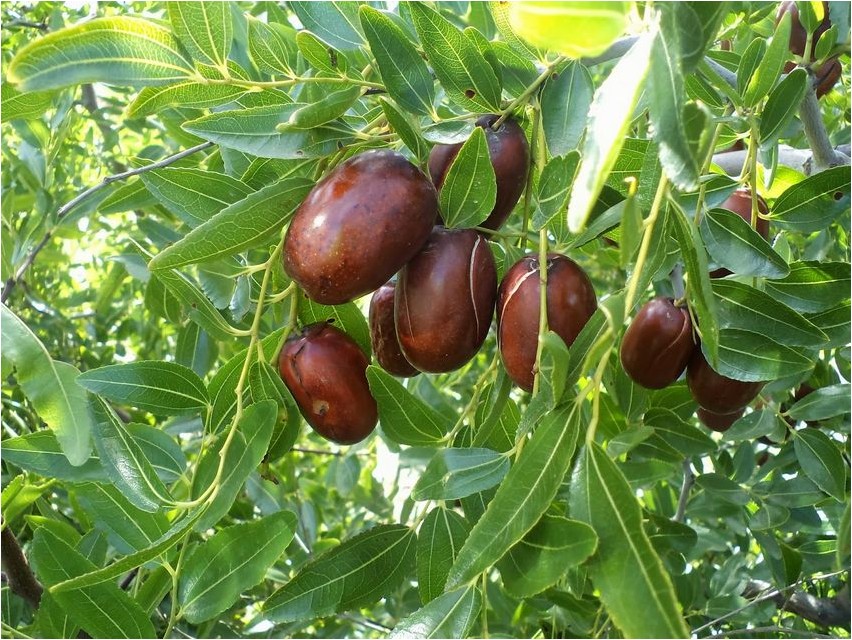
The date (Phoenix dactylifera) is a plant in the Palm family whose fruit is edible. These incredibly nutritious fruits quickly saturate the body with valuable nutrients and are excellent for satisfying sudden hunger.
History
For thousands of years, dates have been and continue to be a staple food in North Africa and the Middle East. Most scholars believe that this crop originated in Mesopotamia, where evidence of its cultivation has been found dating back to 4000 BC. Meanwhile, in India, date palms are believed to have been first domesticated by the Indus Valley Civilization.
Date palms were also frequently depicted on the walls of Assyrian and Babylonian temples. And during the time of Ancient Egypt, the fruit of this unique tree was actively used as a valuable raw material in wine production. Furthermore, dates have been mentioned numerous times in various sacred texts (the Quran, the Bible, etc.). Saint Onuphrius, a hermit in the desert, ate dates. And in Southern Europe, date palm leaves were actively used during Palm Sunday services.
Dates are especially prized in Islam: the Quran mentions them 29 times, and the Prophet Muhammad loved them greatly.
Description
The date palm is a squat shrub or small tree with numerous pinnately divided leaves. The vast majority of trees have only one trunk, but sometimes palms with multiple trunks can be found.
The rather long leaves of this plant are equipped with sharp, very strong spines near the base.

The small yellow flowers are gathered in intricate paniculate inflorescences. The date palm”s fruit is shaped like an elongated berry with a single seed.
Date palm trees begin to bear fruit around the fourth year, although the first full commercial yield is not achieved until five to six years later. Typically, each palm tree yields eight to ten kilograms of dates. Once the trees reach thirteen years of age, their yield increases to sixty to eighty kilograms of dates per palm tree. This high yield is characteristic of this crop for sixty to eighty years.
Beneficial Properties
Just like many other dried fruits, dates are a fairly high-calorie product. Their energy value for every 100 g is over 200 kcal (on average — from 220 to 280). But they do not contain cholesterol.
Dates are very beneficial to eat for various cardiovascular diseases. They also help normalize the functioning of the gastrointestinal tract and are excellent for colds.
In addition, there is a legend according to which the entire complex of substances necessary for adequate human nutrition is contained in dates. And in some legends and tales there are references to the fact that people ate only water and dates for several years in a row.
In terms of glycemic index, dates are real record holders. Therefore, people suffering from diabetes are strongly recommended to dose their use.
In folk medicine, dates have long been used to combat various tumors, oncology, tuberculosis, as well as infectious and some other ailments.
And dried date palm fruits have a very beneficial effect on the brain — its productivity when eating dates increases by 20% or even more.
The Arabs make an excellent paste from dates, which can be easily preserved for a whole year. In addition, wonderful compotes, jelly and muesli are prepared from these fruits. They are no less widely used in the preparation of all kinds of confectionery delights. They also make wonderful honey and very original flour from dates.
Finik. Finya — Forever (Single 2020)