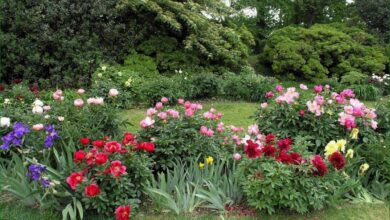
Pieris
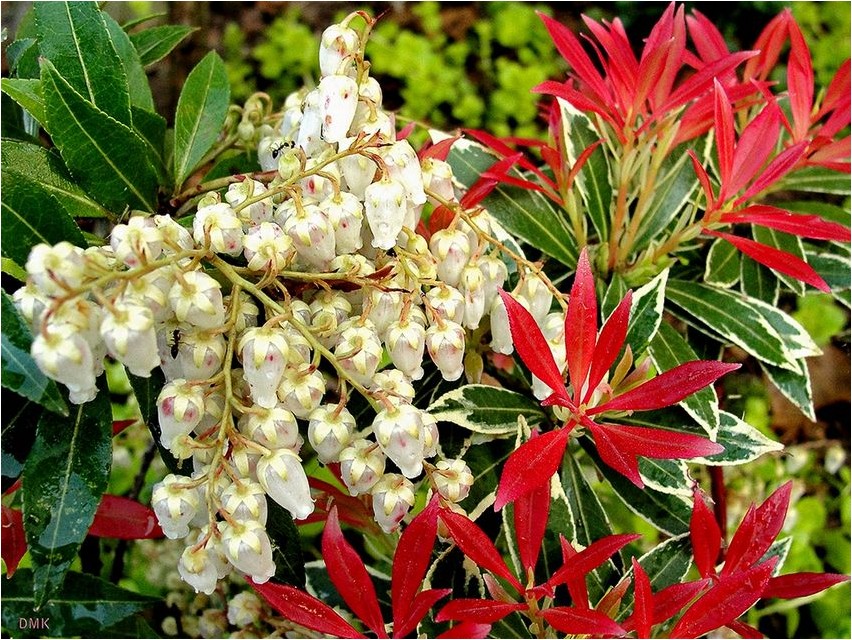
Pieris (lat. Pieris) is a genus of evergreen vines, shrubs and low trees of the Heather family. In nature, plants are distributed mainly in North America and East Asia.
Characteristics of culture
Pieris is a plant whose distinctive feature is its high decorative qualities and the pink or red color of its young shoots. Pieris has been valued by gardeners for many years for its beautiful bell-shaped flowers, which are similar in appearance to lily of the valley flowers. For the most part, pieris are trees and shrubs up to 3-6 m high. Pieris are often found in the form of woody vines, rising to a height of 9-10 m.
The leaves are leathery and shiny, oval, elliptical or lanceolate, entire or serrated, up to 10 cm long. Young leaves are often pinkish, reddish, sometimes white. The flowers are bell-shaped, collected in drooping or erect paniculate inflorescences. The crop blooms in March-May (depending on climatic conditions). Flowering is abundant, especially in sunny areas. The fruit is a woody capsule, divided into five lobes when ripe, containing a large number of seeds. All parts of the plants are poisonous; they contain the glycoside andromedotoxin.
Growing conditions
Pieris prefers acidic, loose, permeable soils with the addition of high-moor peat or a mixture of sawdust, sand and pine needles. The optimal acidity level varies between 3. 5-4. 5. In the future, it is important to maintain the acid level at the same level.
Soil acidification is facilitated by mulching the tree trunk area with pine nut husks, sawdust, pine bark and other organic materials. It is also recommended to systematically add sulfur to the soil.
The location is preferably sunny with protection from cold winds. It is advisable that the plants receive sunlight in the afternoon. Variegated forms need intense lighting, otherwise the foliage becomes monochromatic.

Reproduction and planting
Pieris is propagated by seeds, cuttings, layering and root suckers. The seed method is quite effective, but labor-intensive. Sow the seeds in seedling boxes filled with soil prepared from coniferous soil, acidic peat and sand in a ratio of 2:2:1. After sowing, the soil is watered abundantly, the box is covered with glass and placed in a well-lit and warm place. Shoots appear in 30-35 days. Digging of the entrances to individual containers is carried out with the appearance of 3-4 true leaves on the seedlings. The soil in containers is pre-treated with a solution of foundationazole (to prevent the occurrence of blackleg disease). Seedlings are transplanted into open ground after 2-3 years, in the southern regions in the same summer.
For many gardeners, planting pieris seedlings is most acceptable. Planting holes are prepared 2-3 weeks before the intended planting, the depth of the hole should be about 30-40 cm, and the width — 60-70 cm. On heavy clay soils, the parameters are slightly different: width — 1 m, depth — 15-20 cm. The seedling is planted together with a clod of earth, then the soil in the tree trunk zone is abundantly watered and mulched. Important: the root collar should be located at the level of the soil surface.
Care
Pieris are not cold-resistant; some species can withstand frosts down t o-20C maximum. For the winter, it is recommended to cover the plants with non-woven material, and mulch the tree trunk area with a thick layer of peat. Regular watering is necessary, weeding is also necessary, and loosening should be avoided, since the root system of Pieris is located too close to the soil surface. Pieris does not need a haircut, but formative pruning is not prohibited. The culture has a positive attitude towards fertilizing. Two feedings per season are quite enough.