Avara
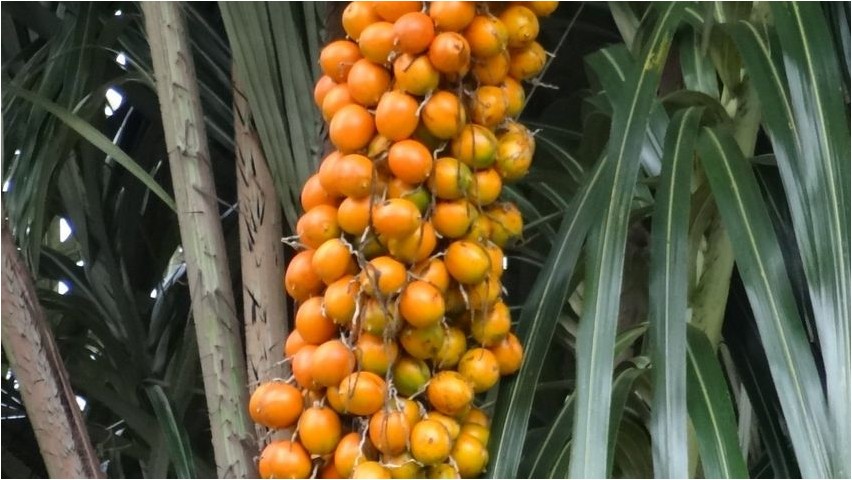
Avara (Latin: Astrocaryum vulgare) is a fruit tree belonging to the Palm family.
Description
Avara is a tree-like plant, often reaching a height of ten to fifteen meters. Its trunks are densely covered with thorns—they can reach up to twenty centimeters in length! Its leaves are also densely covered with sharp spines. All the spines and thorns (both on the trunks and on the leaves) are designed to catch leaves falling from other trees. As the captured leaves decompose, they provide the avara with additional nutrition. Moisture is retained near the bases of the leaf petioles for a very long time, attracting a truly incredible number of scorpions.
However, the avara”s interesting features don”t end there—its flowers grow directly from the trunks near the bases of the branches! After some time, fruit begins to form in the place of these flowers. By the time they are fully ripe, these fruits hang from the trees in impressive clusters, each containing hundreds or even two hundred fruits. Avara is also one of the few crops that can not only grow but also bear fruit at quite impressive altitudes—up to four thousand meters above sea level.
Avara fruits are oval or round, orange or reddish-brown in color, and range in length from three to six centimeters. The flesh is very aromatic and incredibly juicy, with a flavor somewhat reminiscent of apricots. Inside each fruit, you”ll find a huge pit, often occupying up to eighty percent of the fruit”s total volume. The surrounding flesh is approximately 5 mm thick.
Where it grows
Avara is native to the northwestern part of the vast South American continent. Subsequently, as the Indians settled, this crop spread to Suriname, as well as to Guiana and Brazil. Today, it is actively cultivated in virtually all South American countries.
Uses
Numerous South American tribes have long valued the avara for its excellent medicinal and nutritional properties. It is a popular oilseed crop, as the pulp of its fruit contains up to 35% oil, and it is from this pulp that the well-known palm oil is produced. However, on an industrial scale, oil is obtained not from the pulp of the avara, but from its seeds.

The oil from the seeds of this plant is called “chuchu” and is highly valued in folk medicine as a highly effective anti-inflammatory remedy for toothaches, boils, and rheumatism. These properties also allow avara oil to be used in dietetics, pharmaceuticals, and cosmetology.
Avara berries boast impressive carotene and vitamin A content, making them useful for various hair and skin conditions, as well as poor vision.
The pulp of this unusual fruit is a fairly common component in the diets of many South American peoples. For example, the tribes of the Amazon enjoy steaming awara—it serves as a favorite side dish for a wide variety of dishes. Among the people of Guiana, awara is an essential part of the Easter table, always accompanied by a paste made from the juicy orange fruit (a mixture of several dozen other ingredients is stewed in this paste).
In addition to its magnificent fruit, awara also boasts extremely durable, hard, black wood, which has found application not only in construction but also in space technology and the aviation industry. Native Americans weave beautiful baskets from the fibers of young leaves, as well as use them to make fishing nets and ropes.
Contraindications
When consuming awara, one should only take into account any individual intolerance to the product. However, palm oil, produced from Avara seeds, contains a very high percentage of hydrogenated fats, which significantly contribute to elevated cholesterol levels and, consequently, an increased risk of atherosclerosis. So, it”s best to avoid it!





