Stellaria graminea
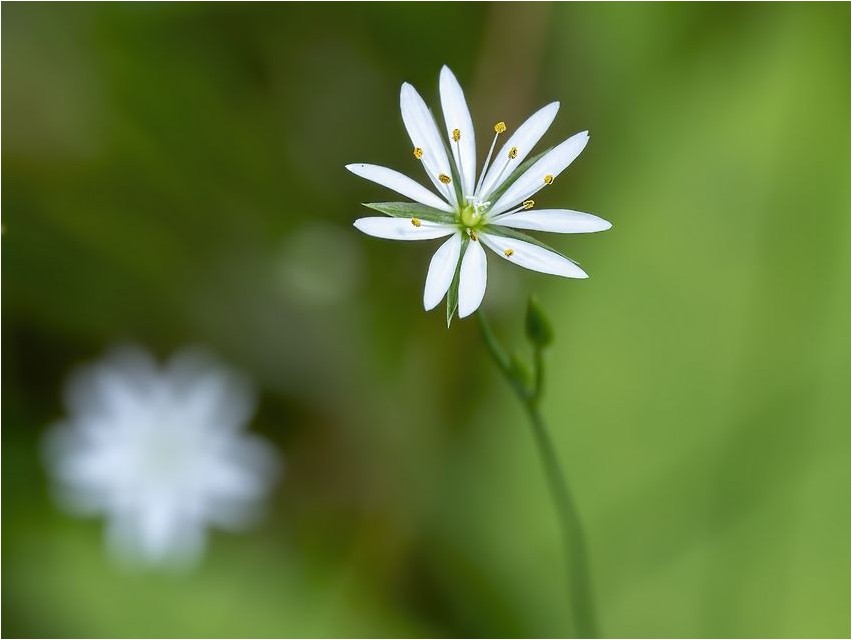
Stellaria graminea is a member of the Caryophyllaceae family. Its Latin name is Stellaria graminea L.
As for the family name of Stellaria graminea itself, its Latin name is Caryophyllaceae Juss.
It’s worth noting that the Latin genus name of this plant shares the same origin as its Russian name: it means “star.” The species name of Stellaria graminea is translated literally. In central Russia, you can also quite often find Stellaria nemorosa and Stellaria lanceolata. A common weed called Stellaria media is also very common: it’s found literally everywhere and is quite difficult to eradicate. Description of the common chickweed
The common chickweed is also known by the following common names: small flower, star grass, sparrow soap, wild flax, soapwort, soapwort, drunken hay, fallow dew, poveka, urochnoye zelye, yasnushka, and chainwort. The common chickweed is a perennial herb with a slender, creeping rhizome. The stems of this plant are slender and tetrahedral, ascending and branched. These stems typically have well-developed, shortened axillary shoots, the height of which varies between twenty and sixty centimeters. The leaves of this plant are opposite and can be lanceolate, linear, or linear-lanceolate. These leaves are ciliated along the margins at the very base. The flowers of the common chickweed are quite small, white, and clustered in a branched, multi-flowered inflorescence. The fruit of this plant is an oblong capsule, noticeably longer than the calyx.
The common chickweed blooms from May to August. In the wild, this plant is found throughout Russia, with the exception of desert regions, as well as in Belarus, Ukraine, and the Transcaucasus. It prefers meadows, fields, steppes, and shrubby areas, and can also be found along riverbanks and forest edges. It is worth noting that common chickweed is poisonous, so extreme caution should be exercised when handling it.
Description of the medicinal properties of common chickweed
Chickweed is endowed with very valuable healing properties, and for medicinal purposes it is recommended to use exclusively the herb of this plant. The term grass includes the leaves, flowers and stems of chickweed. Such raw materials should be harvested from May to August.
It is noteworthy that the chemical composition of this plant has not yet been fully studied, for this reason we can expect the emergence of new ways to use the valuable properties of chickweed.

As for traditional medicine, a tincture prepared from the herb of this plant is quite widely used. This tincture of chickweed grass in the form of drops is recommended for use for coughs, and also as an analgesic for various pains in the intestines and stomach. Crushed chickweed herb has also been widely used: this herb should be used for poultices for various abscesses. It should be noted that the internal use of products based on chickweed will require extreme caution, due to the fact that the plant itself is poisonous.
chickweed 600 medicinal plants