Pyracantha
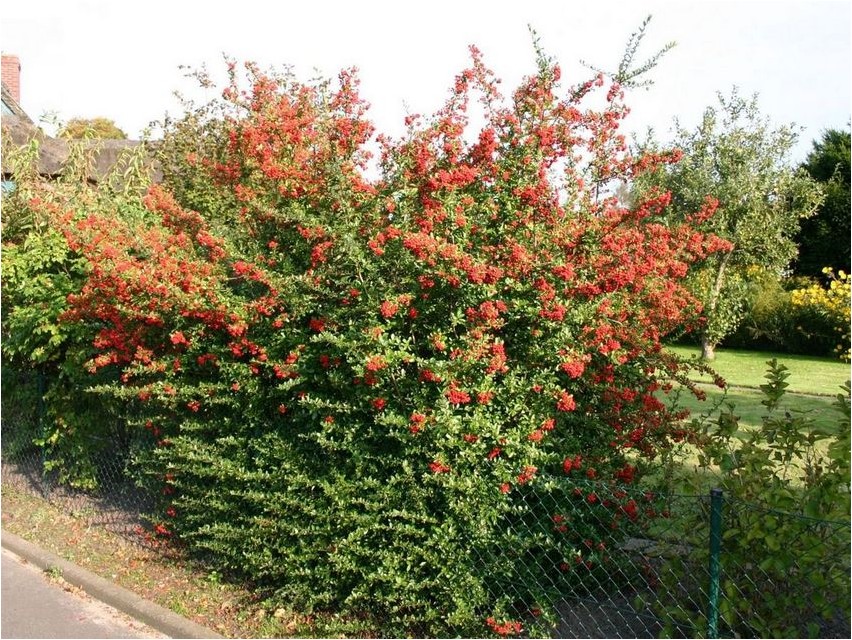
Pyracantha (Latin: Pyracantha) is a genus of evergreen shrubs in the Rosaceae family. The genus comprises six species, distributed primarily in Europe and Southeast Asia.
Cultivation Characteristics
Pyracantha is a spreading or upright shrub up to 5-6 m tall, similar in appearance to members of the genus Cotoneaster, distinguished by shoots armed with 2. 5 cm-long spines. The shoots are covered with fragrant white or whitish-cream flowers, which later form clusters of yellow, orange, or red berries with a glossy surface.
The fruits hang on the shoots for quite a long time, typically throughout the winter, thereby adding to the shrub”s ornamental appeal. The leaves are dark green, oblanceolate to narrowly oblong, notched or obtuse, less commonly pointed, serrated or entire, up to 5 cm long. The fruits are not eaten, although they are not poisonous and pose no harm to humans.
Growing Conditions
Pyracanthas are undemanding and thrive in virtually any soil type. They are undemanding in terms of fertility and light. They can grow in both sunny and shaded areas. In deep shade, pyracantha blooms less profusely and, consequently, produces very few fruits. In such areas, the plants lose their ornamental value. They do not tolerate sites exposed to cold, piercing winds.
Pyracantha thrives in loose, well-aerated, moderately moist soils. When properly grown, pyracantha grows better and faster, sometimes becoming somewhat aggressive toward nearby shrubs. When planted alone, it develops into a large, spreading bush up to 3 meters tall.
Propagation and Planting
Pyracantha is propagated by seeds and cuttings. Sow seeds directly into open ground in spring or fall. In the former case, seeds require preliminary cold stratification. Cuttings are taken in summer. Cuttings are taken from semi-woody shoots and planted in greenhouses.

It is important to protect the cuttings from scorching sunlight, water them regularly, and mist them. Cuttings take root within 2. 5-3 weeks. Young plants are replanted the following spring. For hedges, experienced gardeners recommend using two-year-old seedlings purchased from specialized nurseries. In this case, the distance between plants should be at least 0. 5 m.
Care
Pruning is one of the most important procedures for caring for pyracantha. If pruned at the wrong time, plants become unattractive and even ugly. The crop tolerates pruning easily, so pyracanthas are often used in topiary art. The first pruning is carried out in early spring — dry and damaged shoots are removed; the second before flowering — shorten the horizontal side shoots by 1/3; in the third autumn, strongly overgrown shoots of new growth are removed.
In addition to pruning, watering, weeding and loosening are carried out regularly. During the growing season, plants are fed with mineral fertilizers twice a month. Pyracanthas grown as vertical gardening require support — trellises and drawstrings. With proper and timely care, pyracanthas are practically not affected by pests and diseases. If the maintenance conditions are violated, the crop is attacked by aphids or affected by scab and late blight. When working with bushes, you must be very careful, since pyracantha is “armed” with sharp thorns that can seriously damage your hands.
Usage
Pyracanthas look great in single and group plantings and are ideal for creating hedges. The crop is an excellent honey plant; its aroma attracts bees and the bright berries of birds, which allow you to get rid of annoying pests. Surprisingly, even in winter, plants attract with their beauty and delight others in such a nondescript and sad time of year. Growing pyracantha as a houseplant is not prohibited, although for the winter the plants are taken to cold rooms with a temperature of 1-3C.
PYRAKANTHA unpretentious shrub / Planting and care / Igor Bilevich
Pyracantha

Pyracantha (Latin: Pyracantha) is a genus of evergreen shrubs in the Rosaceae family. The genus comprises six species, distributed primarily in Europe and Southeast Asia.
Cultivation Characteristics
Pyracantha is a spreading or upright shrub up to 5-6 m tall, similar in appearance to members of the genus Cotoneaster, distinguished by shoots armed with 2. 5 cm-long spines. The shoots are covered with fragrant white or whitish-cream flowers, which later form clusters of yellow, orange, or red berries with a glossy surface.
The fruits hang on the shoots for quite a long time, typically throughout the winter, thereby adding to the shrub”s ornamental appeal. The leaves are dark green, oblanceolate to narrowly oblong, notched or obtuse, less commonly pointed, serrated or entire, up to 5 cm long. The fruits are not eaten, although they are not poisonous and pose no harm to humans.
Growing Conditions
Pyracanthas are undemanding and thrive in virtually any soil type. They are undemanding in terms of fertility and light. They can grow in both sunny and shaded areas. In deep shade, pyracantha blooms less profusely and, consequently, produces very few fruits. In such areas, the plants lose their ornamental value. They do not tolerate sites exposed to cold, piercing winds.
Pyracantha thrives in loose, well-aerated, moderately moist soils. When properly grown, pyracantha grows better and faster, sometimes becoming somewhat aggressive toward nearby shrubs. When planted alone, it develops into a large, spreading bush up to 3 meters tall.
Propagation and Planting
Pyracantha is propagated by seeds and cuttings. Sow seeds directly into open ground in spring or fall. In the former case, seeds require preliminary cold stratification. Cuttings are taken in summer. Cuttings are taken from semi-woody shoots and planted in greenhouses.
It is important to protect the cuttings from scorching sunlight, water them regularly, and mist them. Cuttings take root within 2. 5-3 weeks. Young plants are replanted the following spring. For hedges, experienced gardeners recommend using two-year-old seedlings purchased from specialized nurseries. In this case, the distance between plants should be at least 0. 5 m.
Care
Pruning is one of the most important procedures for caring for pyracantha. If pruned at the wrong time, plants become unattractive and even ugly. The crop tolerates pruning easily, so pyracanthas are often used in topiary art. The first pruning is carried out in early spring — dry and damaged shoots are removed; the second before flowering — shorten the horizontal side shoots by 1/3; in the third autumn, strongly overgrown shoots of new growth are removed.
In addition to pruning, watering, weeding and loosening are carried out regularly. During the growing season, plants are fed with mineral fertilizers twice a month. Pyracanthas grown as vertical gardening require support — trellises and drawstrings. With proper and timely care, pyracanthas are practically not affected by pests and diseases. If the maintenance conditions are violated, the crop is attacked by aphids or affected by scab and late blight. When working with bushes, you must be very careful, since pyracantha is “armed” with sharp thorns that can seriously damage your hands.
Usage
Pyracanthas look great in single and group plantings and are ideal for creating hedges. The crop is an excellent honey plant; its aroma attracts bees and the bright berries of birds, which allow you to get rid of annoying pests. Surprisingly, even in winter, plants attract with their beauty and delight others in such a nondescript and sad time of year. Growing pyracantha as a houseplant is not prohibited, although for the winter the plants are taken to cold rooms with a temperature of 1-3C.