Ginkgo
Ginkgo (lat. Ginkgo) is a genus of plants consisting of only one species that managed to survive all the earthly disasters that occurred on the planet for 270 million years.
This is a tree that is called “Ginkgo biloba” for the appearance of its leaves, which in Russian sounds like “Ginkgo biloba”. The tree has a number of advantages: it is an ornamental plant; its leaves contain substances used for medicinal purposes; The fruits of the tree are edible.
What”s in your name
Interestingly, man”s first acquaintance with the Ginkgo biloba tree occurred through the study of fossils, the age of which scientists determined to be at least 270 million years old. For a long time, the tree was listed among the most extinct ancient plant species, and in those days it had about 15 species. Imagine the amazement and joy of scientists when a living Kingko tree was discovered in China, in an area inaccessible to humans, albeit represented by only one species. Who knows, maybe he has relatives on Earth to whom people have not yet been able to trodden paths.
The history of the Latin, difficult to pronounce name of the tree has an almost detective character. On the one hand, it is borrowed from the Japanese language, where the tree is denoted by a hieroglyph, which in English transcription sounds like “ginnan” or “Gin Kyo” and means “silver apricot”. On the other hand, errors or typos were made during romanization, which resulted in the name “Kinkgo”. They also added the adjective “biloba”, derived from two Latin words “bis” (two) and “loba” (separate), referring to the shape of the leaves.
Description
Although Ginkgo is a gymnosperm plant, that is, less protected from the vicissitudes of life, it managed to survive and remain in nature to this day. Perhaps the division into male and female individuals helped in this tree, that is, as botanists say, Ginkgo is a dioecious plant.
Trees live an enviably long time. Scientists have determined the age of some old-timers, which turned out to be 4 thousand years. This lifespan allows trees to take their time to mature, and therefore flowers appear on the branches, at best, after thirty years of life. Only at this age can you determine the sex of a tree by looking at the blossoms.

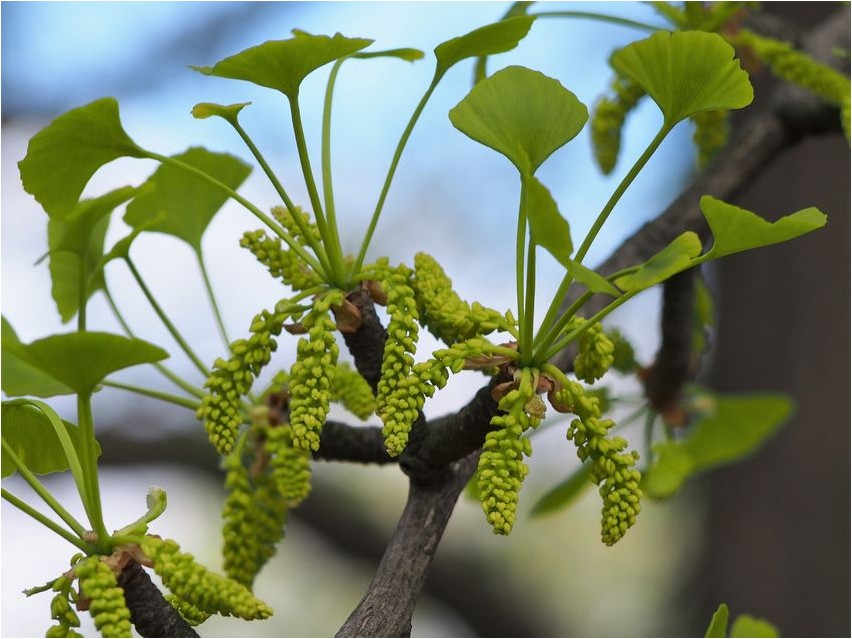
After all, male and female trees bloom differently. Male specimens, awakening from winter hibernation, simultaneously with the tender spring leaves show the world inflorescences similar to earrings, not quite golden in color, but yellowish.
Oddly enough, female flowers do not try to attract attention with their appearance, appearing as rather inconspicuous single creatures on long stalks. Only occasionally do they betray their loneliness by appearing in pairs. And they are in no hurry to meet their “betrothed”, appearing on women’s trees only in the summer.
Be that as it may, the meeting of male pollen with female flowers occurs, and green fruits hang on the branches, turning yellow as they ripen. That”s why the Japanese call them “apricots.” Often the ripening of fruits picked from branches occurs on the ground, spreading a not very pleasant smell around them.
However, the smell does not prevent the local population from using the fruits for food. They are boiled, fried and, flavored with hot spices, eaten with pleasure.
Healing abilities
Healing potions are prepared from Ginkgo leaves. With their help, they strengthen the circulatory system, adding elasticity to blood vessels, freeing them from harmful cholesterol. When the blood is cleaner and more protected, then the whole body works like a Swiss watch.
Use in landscaping
The decorative appearance of the leaves and the lush crown of the tree attract landscape designers to Ginkgo. A stoic attitude towards air pollution adds to the attractiveness of trees for landscaping our cities, saturated with industrial fumes.