Gray blackberry
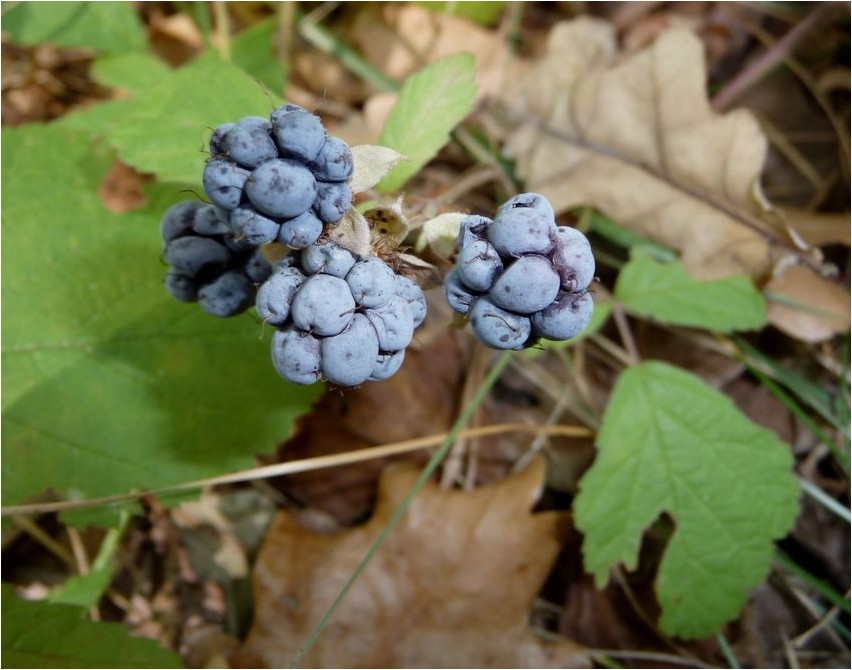
Gray blackberry is one of the plants of the family called Rosaceae; in Latin the name of this plant will be as follows: Rubus caesius L.
As for the name of the gray blackberry family itself, in Latin it will be: Rosaceae Juss.
Description of gray blackberries
Gray blackberry is a subshrub endowed with prostrate thorny shoots, the length of which reaches one and a half meters. Shoots can be of two types: biennial generative and annual vegetative. The leaves of the plant are petiolate, trifoliate and alternate. Gray blackberry flowers are white in color, they are quite large and their length can reach three centimeters. Such flowers are collected in corymbose inflorescences. There are a lot of stamens and pistils of this plant. The fruits are quite large and ovoid, they are colored black and will grow tightly to the receptacle.
Blue blackberries bloom from May to August, while fruit ripening begins a month after flowering ends. The plant will bear fruit every year and quite abundantly. Under natural conditions, blue blackberries can be found throughout the European part of Russia, as well as in Kazakhstan, Central Asia, Ukraine, Belarus and the Caucasus. For growth, the plant prefers valleys of rivers and streams, as well as damp forests, ravines, clearings and places in bushes. In the Crimea and the Caucasus you can find other types of this plant: bristly blackberry and Caucasian blackberry.
Description of the medicinal properties of blue blackberries
The blue blackberry is endowed with quite valuable medicinal properties, and the leaves and fruits, as well as the juice of the plant and its roots, should be used for medicinal purposes. Leaves and juice should be harvested around June-August, roots – in the autumn, and fruits – throughout August and September.
The presence of such valuable healing properties is explained by the content of organic acids, fiber, fructose, sucrose, glucose, potassium salts, copper, manganese, iron, phosphorus and vitamins B, C, A and E in blackberry berries. The leaves contain tannin, tannins, flavonoids, inositol, carotene, phytoncides, as well as malic, oxalic, tartaric and lactic acid.

It should be noted that even in ancient times the healing properties of this plant were known. The infusion was used for gargling and for inflammatory gum diseases. In the Middle Ages, it was already proven that blackberry root has a diuretic effect. As for traditional medicine, here this plant is used as a hemostatic, astringent, anti-inflammatory, wound healing, sedative, anthelmintic, diuretic and blood purifier. Blackberries are also used for bronchitis, pneumonia, liver and kidney diseases, gastritis, anemia, stomach bleeding, upper respiratory tract diseases, shortness of breath, atherosclerosis and hypertension.
It is noteworthy that it has been proven that the extract of the leaves of this plant is endowed with a fairly pronounced antiviral effect against the hepatitis virus, as well as a moderate cytotoxic effect.
Crushed blackberry leaves in the form of a poultice can be applied to trophic ulcers and lichens, as well as to purulent wounds and chronic ulcers. To prepare a diuretic, you will need to take ten grams of the roots of the plant in one glass of water: this remedy is taken half a glass two to three times a day before meals.
A 100% decoction of the leaves or root can be used as a diuretic, astringent and diaphoretic: this remedy is drunk one-third of a glass three to four times a day.





