Monarda
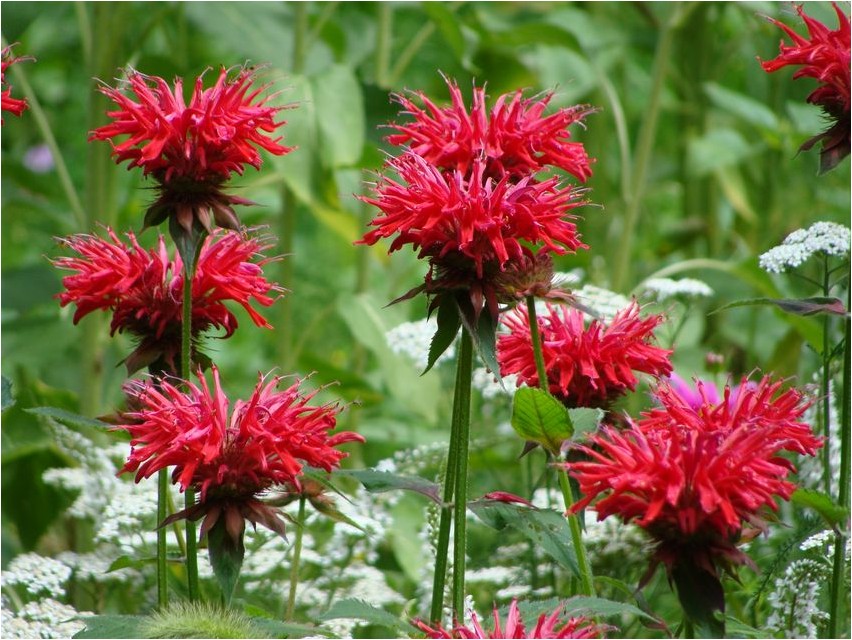
Monarda (lat. Monarda) – flower crop; perennial plant of the Lamiaceae family. The plant is native to North America.
Currently, 20 species are known. The plant was named after the physician and botanist Nicholas Monardes.
Characteristics of culture
Monarda is a herbaceous plant that forms fairly dense bushes 60-80 cm high. The rhizome is long, creeping, with a large number of fibrous roots. The stem is erect, rigid, tetrahedral, hollow, highly branched or glabrous.
The leaves are green or purple-green, oval-lanceolate, smooth, toothed, arranged oppositely on short petioles. The flowers are two-lipped, tubular-funnel-shaped, collected in capitate inflorescences in the axils of the stems or at the top of the stem. The fruit is a dry nut that cracks into four parts. Monarda blooms in June – October, usually for no more than a month.
Growing conditions

Monarda is a light-loving plant, prefers sunny places. Some species grow and develop well in semi-shaded areas. The culture has a negative attitude towards strong and piercing winds. Soils for growing monarda are preferably moderately moist, fertilized, light and drained with a neutral pH. Acidic soils are not suitable for monarda. The plant is frost-resistant and successfully withstands seasonal frosts and winter frosts. A monad can grow in one place for 5-6 years.
Reproduction
Monarda is propagated by seeds, cuttings, root suckers and dividing the bush. Sowing of seeds is carried out in early spring, or rather in March, in seedling boxes. The seeding depth is 1-2 cm. The crops are covered with plastic film and placed in a room with an air temperature of 20-25C. Shoots appear quickly, but develop extremely slowly. When 2-3 true leaves appear on the seedlings, the plants are planted in separate pots. Seedlings are planted in open ground after the end of spring frosts.
Monarda is often propagated by dividing bushes and cuttings of rhizomes. These procedures are carried out in the spring before shoots begin to grow. Green cuttings are cut in June-July. The lower leaves of the planting material are removed, the rest are cut off by 1/3, planted in a container with sand and covered with glass.
Care
Monarda is drought-resistant, but requires regular and moderate watering, especially during budding. To preserve moisture, the soil in the stem zone is mulched with peat or humus. The culture has a positive attitude towards fertilizing: the first fertilizing with mineral fertilizers is carried out 10-12 days after planting the plants in open ground, the second – after a couple of weeks with organic fertilizers. In autumn, the monarda is trimmed and covered with sawdust or any other material.
Application
Monarda is a beautifully flowering and highly decorative plant, but it is rarely used in modern gardens, and in vain. The culture retains its decorative value for quite a long time: first it attracts the eye with its abundant flowering, and then its flower stalks with fruits decorate the flower beds with an unusually exotic look, complementing the autumn landscape.
Monarda is used in both single and group plantings. Perfectly complements rustic flower beds. The plant is combined with catnip, rudbeckia, yarrow, phlox, aconite, speedwell, sage, astilbe, gaillardia and various cereals. Monarda is also irreplaceable in the herb garden. The culture is used in cooking as a seasoning, as well as in folk medicine. Suitable for making live and dry bouquets.





