Ruysha snakehead
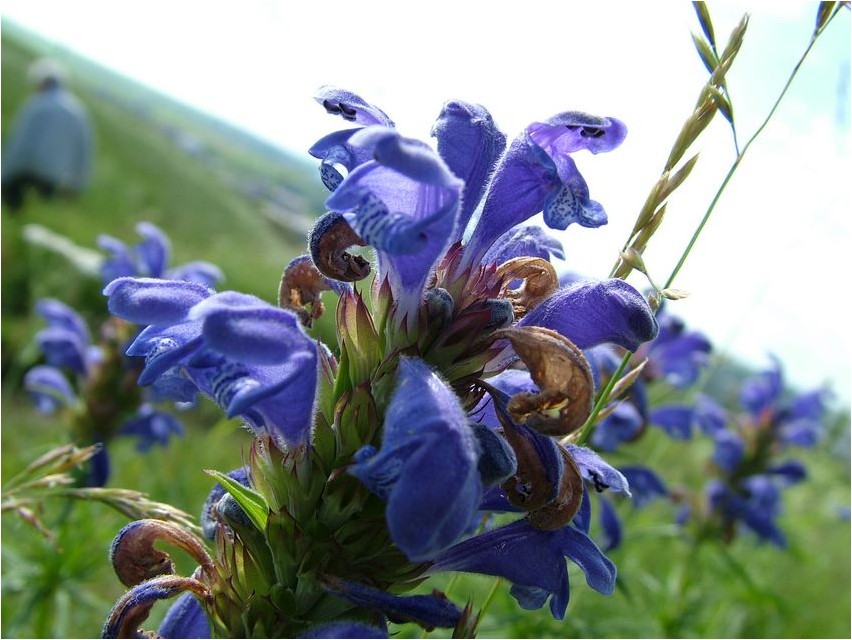
Ruysch’s snakehead is one of the plants of the family called Lamiaceae; in Latin the name of this plant will be as follows: Dracocephalum ruyschiana L.
As for the name of the Ruysch snakehead family itself, in Latin it will be like this: Lamiaceae Lindl.
Description of the Ruysch snakehead
The Ruysch snakehead is a perennial herbaceous plant, endowed with a branched rhizome, the height of which will be about forty to sixty centimeters. The Ruysch snakehead has several stems, all of them are erect. The leaves will be sessile, they can be either linear or lanceolate-linear, the leaves are also obtuse, they are endowed with solid, complete edges, and on top they are painted in dark green tones, from below such leaves will be lighter and they are endowed with dotted glands. The inflorescence of Drakehead Ruysch will be spike-shaped, it is more or less dense and rather short, and either round or short-oval. The bracts of the plant will be pointed and ovate-lanceolate, with the upper tooth of the calyx being one and a half to two times wider than all the others. The length of such a corolla is twenty to twenty-eight millimeters, and it is painted in bright blue tones.
The flowering of the Ruysch snakehead occurs in the summer. Under natural conditions, this plant can be found in the European part of Russia, Ukraine, Siberia, the Caucasus, Central Asia and Kazakhstan. For growth, the plant prefers steppes, rocky slopes, light forests, mainly pine, as well as clearings, fallow lands and meadows.
Description of the medicinal properties of the Ruysch snakehead
The Ruysch snakehead is endowed with very valuable healing properties, and it is recommended to use the herb of this plant for medicinal purposes. Such raw materials should be harvested during the flowering of this plant. The term grass includes leaves, flowers and stems.
The presence of such valuable healing properties is due to the content of essential oil and flavonoids in the herb of this plant. Fatty oil was found in the seeds, which contains stearic, palmitic, oleic, linolenic and linoleic acid.

As for traditional medicine, an infusion of the herb of this plant has become quite widespread. This infusion is used as an antispasmodic, tonic, potency enhancer and astringent, and is also successfully used for headaches, colitis, enterocolitis and respiratory diseases. Externally in the form of compresses, an infusion of the herb is used for rheumatism.
Powder prepared from the herb of the dragonhead ruysch is used for various diseases of the esophagus and stomach ulcers. Flower nectar is active against gram-negative and gram-positive bacteria.
It should be noted that the fatty oil of this plant is quite widely used in the paint and varnish industry. The Ruysch snakehead is a plant also endowed with decorative properties.
For impotence, it is recommended to use the following quite effective remedy based on the Ruysch snakehead: to prepare such a remedy, take one tablespoon of the herb of this plant per glass of boiling water. The resulting mixture should be infused for twenty to thirty minutes in a sealed container, after which this mixture is filtered very carefully. Take this remedy three times a day, one or two tablespoons.
For stomach and duodenal ulcers, you should take one gram of herbal powder thirty minutes before meals, washing down the powder with plenty of water.





