Privet
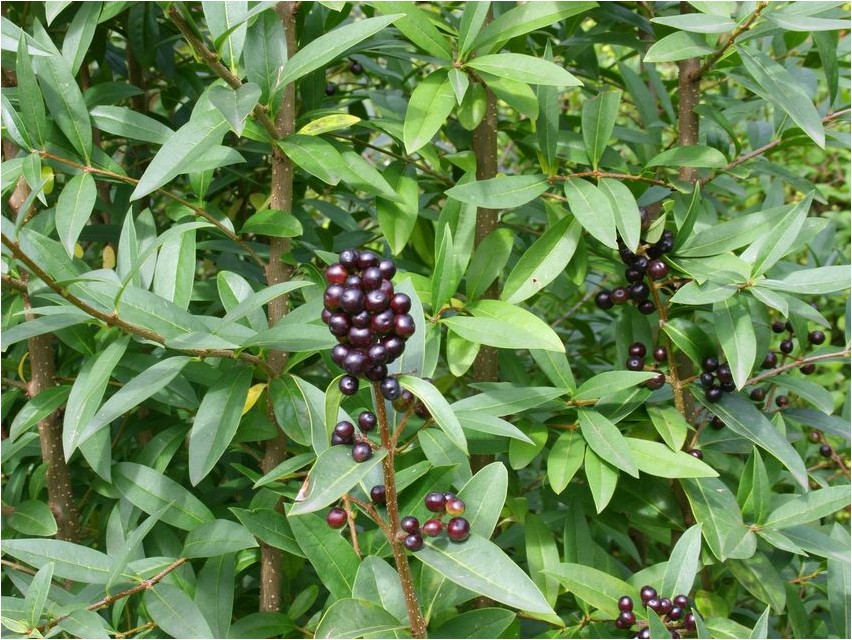
Privet (Latin: Ligustrum) is a genus of shrubs and trees in the Oleaceae family. There are approximately 50 species. In the wild, privet grows in warm deciduous and floodplain forests, as well as oak-hornbeam groves.
The plant is widespread in North Africa, Europe, Asia, Australia, and the Himalayas. Privet is grown in large quantities in Taiwan, Ukraine, the Caucasus, Japan, China, Moldova, and Russia.
Cultivation Characteristics
Privet is an evergreen, semi-evergreen, or deciduous shrub or small tree up to 5 m tall with a broad, spreading crown. The leaves are simple, entire, pointed, opposite, leathery, oblong or lanceolate, dark green, and yellow or marginated in some species. The flowers are small, white, and have a pleasant, distinct aroma. They are gathered in dense, upright racemes or paniculate inflorescences. Privet blooms in June and July.
The fruit is a 1-4-seeded drupe, poisonous, round, bluish-black, and glossy. It ripens in September and October and remains on the plant until mid-winter. Privet is characterized by rapid growth and drought resistance, but it is not known for its winter hardiness. Of all known species, common privet is the most winter-hardy; other species can freeze to the ground. Some forms are capable of regenerating from dormant buds, but this is extremely rare.
Growing Conditions

Privet prefers well-lit areas; some species grow well in partial shade. Any garden soil, moderately moist with a neutral pH, is preferable. Acidic, saline, waterlogged, and heavy clay soils are not suitable for growing this crop. Soils with high lime content are acceptable.
Propagation and Planting
Privet is propagated by seeds, cuttings, and layering. Seeds undergo prolonged stratification before sowing. In central Russia, it is preferable to grow privet by planting seedlings. It is recommended to purchase seedlings from specialized nurseries.
Prepare the planting hole 2-3 weeks in advance; its depth and width should be 30 cm and 60 cm greater, respectively. When forming a hedge, space seedlings approximately 30 cm apart, and 15-30 cm away from paths, buildings, and other objects. Before planting, soak the seedling in a bucket of water for 1 hour. The hole is also filled with water, and after it has completely soaked in, a mixture of soil and compost in a 1:1 ratio is placed on the bottom.
The seedling is lowered into the hole, the roots are straightened and covered. For 3-4 weeks, the soil in the tree trunk zone is constantly kept moist, and then watering is carried out as needed. It is advisable to mulch the tree trunk circle with peat or healthy fallen leaves with a layer of 5-7 cm.
Care
Privet is an unpretentious plant and needs loosening throughout the season. This procedure promotes better aeration and protects the root system from overheating. Mulching is an equally important procedure for caring for crops. The first mulching is carried out in mid-May, it is at this time that the soil is sufficiently warmed up and moderately moistened.
Privet is favorable to pruning. The shrub forms a densely branched crown, so it is also good for pruning. Plants can be used to form various decorative shapes that will become a real highlight of the garden plot. Privet is trimmed in May and August. This should be done in the evening; immediately after cutting, the plants are covered with a damp cloth for 12 hours. Haircutting during flowering is prohibited. Sanitary pruning is carried out in early spring. In winter, the plants are bent to the ground and covered, and when precipitation appears, they are covered with a dense layer of snow.
Privet is watered about 5-6 times per season. Watering rate is 35-40 liters per 1 sq. m. Rare and abundant watering is more effective than frequent and small amounts of water. The culture has a positive attitude towards fertilizing; it is enough to apply fertilizers once every 2-3 years. Fertilizing is carried out in early spring, when the average daily air temperature reaches +5C. The plants themselves and the soil around them are sprayed with a 5% urea solution. In autumn, privet is fed with potassium fertilizers (15 g per 1 sq. m).
Application
Privet is a highly decorative plant, used in solitary, border and group plantings. Culture can be an excellent decoration for fences, walls of houses and other buildings. Traditionally, winter-hardy varieties of privet are used to create hedges. The plant looks great in combination with perennials, shrubs and low-growing trees.





