Robinia
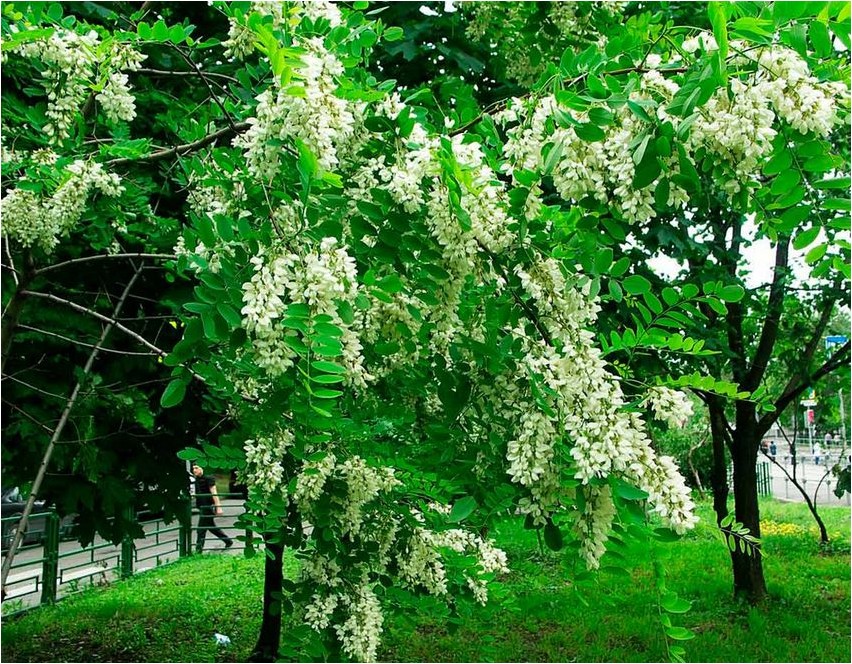
Robinia (lat. Robinia) is a genus of shrubs and trees of the legume family (Fabaceae). Robinia is native to North America and northern Mexico.
Today, the plant is naturalized throughout Europe, South and North Africa, Asia, New Zealand, Australia and South America.
Characteristics of culture
Robinia is a highly ornamental shrub or tree 4-25 m high (there are specimens up to 35 m high), with an openwork spreading crown consisting of separate, slightly translucent tiers. The leaves are compound, odd-pinnate, rich green, golden-green or gray-green, up to 25 cm long, consist of 7-19 leaflets, arranged alternately. The leaves are petiolate, elliptical or obovate, with a soft subulate-shaped stipule.
flowers are moth-type, purple, white or pink in color, collected in large axillary racemes on the shoots of the current year. The calyx is bell-shaped, has five wide teeth, two of them fused. The corolla is longer than the calyx, rounded, slightly curved back, equipped with a short nail. The fruit is an oblong, multi-seeded, bivalve, laterally flattened bean, which can be gray or brown. The seeds are smooth, kidney-shaped. Robinia blooms in May-June.
Growing conditions

Robinia prefers well-drained, moderately moist and light soils with a slightly acidic or neutral pH. It develops best in intensely lit areas, but also produces rich foliage and abundant flowering in partial shade.
Negatively relates to soil compaction and stagnation of cold water. The culture is resistant to drought, winds and severe frosts. Only shoots of young trees are susceptible to freezing, which quickly recover with the onset of spring.
Reproduction and planting
The simplest, most effective and common way to propagate Robinia is by sowing seeds. Sowing is carried out in the spring. Before sowing, the seeds are stratified or treated with hot water followed by immersion in cold water. Without drying, the seeds are sown in moist soil in a greenhouse or greenhouse. The optimal temperature for germination is 20-25C.
Crops are watered regularly, avoiding waterlogging, and weeds are controlled. The emerging seedlings are sprayed with phytogrowth stimulants (Larixin, Novosil or Epin). Young plants are covered for the winter, and next spring they are transplanted to a permanent place. Very rarely, gardeners propagate the crop by root suckers, and for some forms they use grafting.
Care
Robinia is considered an easy-to-grow plant and undemanding of specific growing conditions. Care consists of moderate and regular watering, fertilizing, weeding, and annual crown pruning or trimming. Fertilizing is done three to four times with slurry diluted with water, or with bird droppings and granulated complex fertilizer. Fertilizing is not recommended from August onward.
It”s important to remember that Robinia does not tolerate sodding, so the area around the trunk should be free of long-rhizome grasses. Avoid planting pears, apples, and other fruit trees near Robinia, as their root systems can suppress the plant.
Applications
Robinia is widely cultivated in many countries worldwide due to its high ornamental value. Robinia is often used in landscape design as a specimen, in group plantings, and for landscaping streets and parks. Robinia is ideal for creating hedges and espaliers. Today, there is a wide range of selectively cultivated varieties and hybrids of Robinia, distinguished by their beautiful crowns, delicate foliage, and vibrant blooms.
Robinia tolerates pruning well, so the shrubs can be shaped into a wide variety of shapes. Robinia pseudoacacia is an early honey plant and is often used to stabilize railway embankments, sand, ravines, and to create windbreaks. Its flowers have found use in herbal medicine and homeopathy, and its dense, rot-resistant wood is an excellent material for railroad ties, piles, and parquet flooring.





