Mytnik cute
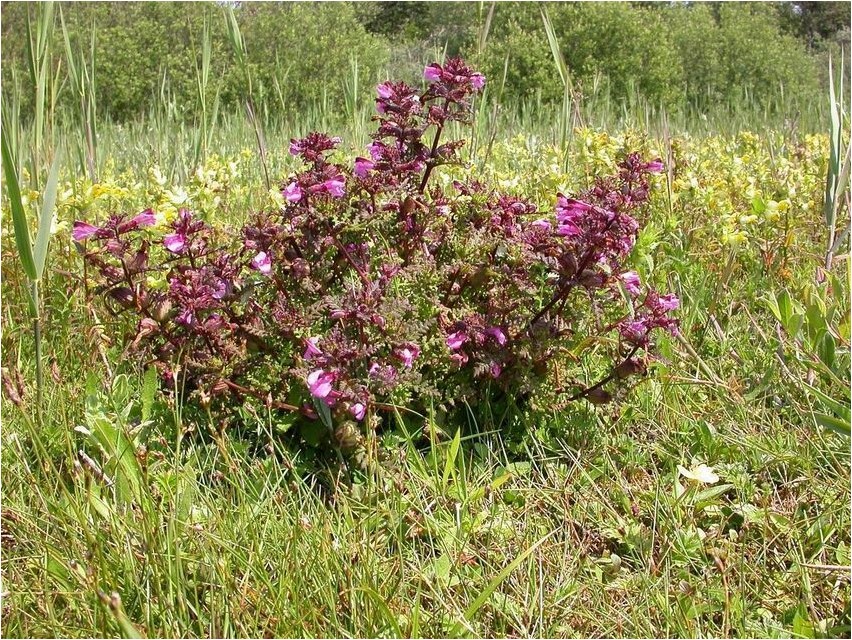
Mytnik milividny is one of the plants of the family called Noricaceae; in Latin the name of this plant will be as follows: Pedicularis venustra Bunge.
As for the name of the family of the mystic grass family itself, in Latin it will be like this: Scrophulariaceae Juss.
Description of the pretty mytnik
Mytnik milividny is a perennial herbaceous plant, which is also a semi-parasite, and its height will fluctuate between ten and forty centimeters. The stem of this plant is thin, the few basal leaves of the myeloid grass will be pinnately dissected into deeply pinnately divided segments. The flowers of this plant are located in a rather dense inflorescence, they will be almost sessile, and the corolla itself is painted in yellow tones, its length will be about twenty to twenty-five millimeters, while the middle bracts are five-lobed.
Under natural conditions, this plant is found in Central Asia, the Far East, Western and Eastern Siberia. For its growth, the sweet grass prefers sandy river banks, forests, saline meadows and thickets of bushes.
Description of the medicinal properties of Mytnik milovidny
Mytnik milovidna is endowed with very valuable healing properties, and for medicinal purposes it is recommended to use the flowers, roots and grass of this plant. The concept of grass includes stems, leaves and flowers. The presence of such valuable healing properties is recommended to be explained by the content of saponins, coumarins, alkaloids, as well as aucubin iridoids, harpagide derivatives, aucubin and the following flavonoids in this plant: apigenin, kaempferol, quercetin and luteolin.
Mytnik milovida is endowed with very effective hemostatic, anti-inflammatory, hypotensive and cardiotonic effects. A decoction prepared from the roots of this plant has a diuretic effect. A decoction based on the herb of the mint grass is indicated for use as an anti-inflammatory, diuretic and hemostatic agent, and is also used for diarrhea, syphilis, metrorrhagia, hyperkeratosis of the scalp and for the resorption of hemorrhoids.

As for traditional medicine, here this plant is quite widespread. An infusion prepared from the flowers of the myeloid grass is used for neurasthenia, pulmonary tuberculosis, pneumonia, nephritis and tendon rupture, and is also used as a hemostatic and diuretic. It is noteworthy that a decoction prepared from the herb of this plant is also used in veterinary medicine. Here, such a decoction based on the herb of the myeloid grass is used for coughs in horses and for rabies in dogs.
As a diuretic, it is recommended to use the following very effective remedy based on Mytaria miliformis: to prepare such a healing remedy, you will need to take one teaspoon of crushed roots of this plant per glass of boiling water. The resulting mixture should be infused for about two hours, and then it is recommended to strain this mixture very carefully. Take the resulting medicinal product based on Mytnik milovidna three times a day, one tablespoon. It is important to remember that in order to achieve the greatest effectiveness when taking such a remedy, it is recommended not only to strictly follow all the rules for taking such a medicinal product, but also to comply with all the rules for taking a medicinal product based on Mytaria myelidae. In this case, such a remedy will be very effective.
Mytnik swamp: medicinal properties and applications.
https://www. youtube. com/watch? v=lA9rX8JkZpU





