Periwinkle
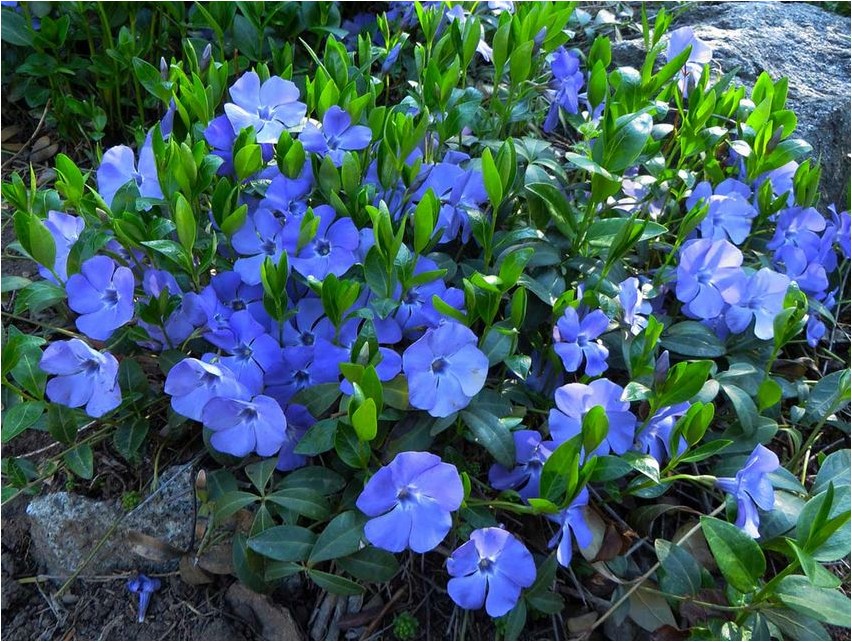
Periwinkle (lat. Vinca) is a flower crop; perennial plant of the Kutrov family (Apocynaceae). Other names: burial ground, coffin-grass.
Under natural conditions, periwinkle grows in Asia, North Africa, as well as in regions of Europe with a temperate climate.
Characteristics of culture
Periwinkle is an evergreen or deciduous creeping subshrub or herb with erect, highly branched shoots. The leaves are rich green, smooth with a shine or leathery, elliptical or ovoid in shape, arranged oppositely.
The flowers are large, solitary, axillary, reaching 3-7 cm in diameter. The calyx is small, with narrow and sharp lobes, and equipped with miniature teeth at the base. The corolla is fused-petalled, funnel-shaped, with a long cylindrical tube, bare or pubescent in the throat, and has a five-parted wheel-shaped limb. The fruit is a double cylindrical leaflet. The seeds are elongated, without a tuft.
Growing conditions

Periwinkle develops well and blooms profusely in both sunny and shaded areas. The crop is not demanding regarding soil conditions, however, it develops best on fertile, loose, moderately moist and well-drained soils with a neutral pH reaction.
Reproduction and planting
Periwinkle is propagated by seeds, cuttings, layering and dividing the bush. In cultivated form, periwinkle rarely produces seeds, so it is most often propagated by cuttings. Cuttings are cut in late August – early September. The cuttings take root quickly enough and at the end of September they are transplanted to a permanent place. Young plants are mulched with peat or humus for the winter, especially for pubescent periwinkle.
Evergreen forms of periwinkles are propagated by layering; for this purpose, the lodged stems are pinned to the soil in shallow grooves. Immediately after rooting, the cuttings are separated from the mother plant. With proper care and favorable conditions, the crop grows strongly and displaces other plants, so it needs to be thinned out and replanted in a timely manner.
Care
Periwinkle is considered a resilient and undemanding plant. It requires regular and moderate watering, especially during flowering. It responds well to organic and mineral fertilizers. Young plants can be pinched to achieve fuller bushes. Most periwinkles are frost-hardy, but in central Russia, they require winter protection. Diseases and pests are extremely rare, so preventative treatments are unnecessary.
Uses
Periwinkle is a beautifully flowering and highly decorative plant, often used for landscaping shady areas. Lesser periwinkle fits harmoniously into rock gardens, such as rockeries and alpine gardens. Plants are also grown under the canopies of trees and lush shrubs. It is also used as a groundcover.
Some varieties are grown in containers and pots, such as the herbaceous periwinkle and the pink periwinkle. The second type looks especially impressive; its shoots hang gracefully over the sides of the container, covering it with a green “cloak.” Ideal companions include ornamental shrubs and trees, as well as shade-tolerant and low-growing plants such as epimedium, lungwort, primrose, scilla, hyacinth, heuchera, forget-me-not, and others.
The plant is also used in folk medicine; periwinkle is believed to be beneficial for diarrhea, scurvy, bleeding, and toothache. All parts of the plant contain an alkaloid with properties that inhibit cell division and prevent the formation of various tumors. Extracts and compounds from periwinkle are used in immunosuppressants, antitumor, and nootropic medications.





