Gapega
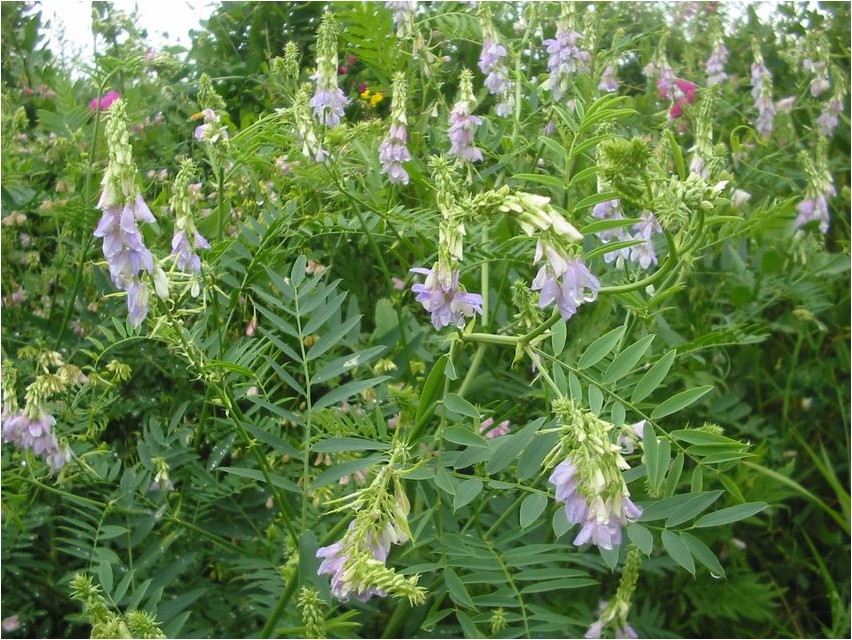
Gapega is also known as goat’s rue; in Latin the name of this plant will be as follows: Galega officinalis L.
Gapega is one of the plants of the family called legumes, in Latin the name of this family will be: Fabaceae Lindl.
Description of Gapega
There are also the following popular names for this plant: goat intestine, rutovka, rue and goat grass. Gapega is a perennial herbaceous plant whose height can reach from forty to two hundred and fifty centimeters. The root of this plant will be a taproot. The stems of Gapega are very numerous, branched and erect. The leaves of this plant are endowed with stipules; they will be odd-pinnate and petiolate. Such leaves are endowed with approximately five to ten pairs of linear-lanceolate leaflets, and at the top these leaves are pointed. The flowers of this plant are most often painted in light blue tones, they are endowed with rather long pedicels, they are numerous and collected in dense axillary racemes. The calyx of this plant will be bell-shaped, and the corolla will be painted in light blue tones or sometimes pale purple, such a corolla will be moth-shaped. There are ten fused stamens, and the pistil is endowed with an upper ovary, as well as a capitate stigma and a rather long style. The fruits of this plant will be multi-seeded and their length will be about two to four centimeters. Gapega seeds will be slightly kidney-shaped, smooth and greenish-yellow in color.
Under natural conditions, this plant is quite widespread in Moldova, the Caucasus, as well as in the Crimea, the Carpathians and the Dnieper region of Ukraine. In addition, gapega can also be found in the Lower Volga and Black Sea regions of the European part of Russia. For growth, this plant prefers streams, banks and river valleys, roads, ravines, shrubs, beech forests, mountain steppes, forest edges, as well as humid subtropical forests.
Description of the medicinal properties of Gapega
It should be noted that gapega is endowed with quite valuable healing properties, and it is recommended to use the seeds and herbs of this plant for medicinal purposes. The concept of grass includes the flowers, leaves and stems of this plant.
Such valuable medicinal properties are explained by the content of saponins, alkaloids in the plant, as well as the following nitrogen-containing compounds: galegin and 4-hydroxygalegin. The roots of this plant contain triterpenoids. The herb of this plant contains alkaloids, carbohydrates, peganin, vasicinone, and in addition other nitrogen-containing compounds: namely tannins, pipecolic acid, rutin, flavonoids, kaempferol, carotene, vitamin C, and in addition also phenolcarboxylic acids and even their derivatives in the hydrolyzate. Derivatives of such acids will be coumaric, sinapic, ferulic and caffeic acids. Gapega flowers contain flavonoids. The seeds of this plant contain saponins, alkaloids, stachyose, steroids, fatty oil, as well as other nitrogen-containing compounds, as well as linolenic, linoleic, stearic and palmitic acids.

It should be noted that preparations based on this plant have a diaphoretic, diuretic effect, and also increase milk secretion in women in labor. In veterinary medicine, the herb of this plant is widely used as a lactogenic agent. Actually, the experiment showed that the herb extract of this plant can increase the glycogen content in the liver, as well as glucose tolerance. In addition, galegin can also have a hypoglycemic effect, and peganin will tone smooth muscles. It should be remembered that long-term use of drugs based on this plant can lead to increased blood pressure or impaired intestinal function.