Buzulnik
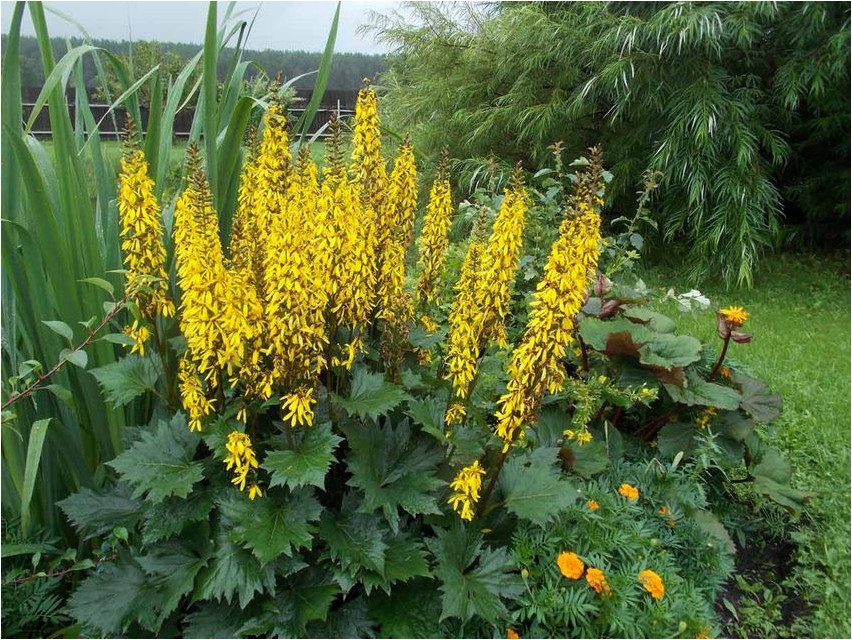
Buzulnik (lat. Ligularia) is a beautifully flowering ornamental crop belonging to the Asteraceae, or Asteraceae, family. The plant is often called Ligularia or Ligularia.
Under natural conditions, buzulnik is found in forest edges, near water bodies and other areas with moist soils in Asia and the European part of Russia. Currently there are about 20 species, only ten of them are grown in culture.
Description
Buzulniki are perennial herbaceous plants that, during the process of growth, form a basal rosette of large triangular or core leaves, pubescent over the entire surface and jagged along the edge. The foliage does not exceed 60 mm in length and 70 mm in width, depending on the species they can be green, dark green or brown with a reddish tint.
The inflorescences are baskets and consist of small tubular flowers with yellow, orange or red marginal flowers. The moths, in turn, are collected into brushes, scutes or panicles. The peduncles are tall, sometimes reaching 200 cm. The fruits are represented by achenes with tufts. The flowering of the crop in question is observed all summer until the onset of cold weather.
Features of cultivation
Buzulnik is an unpretentious plant, but develops best in moist, not too heavy clay soils. You can grow crops near ponds. Buzulnik is favorable towards shady areas, but has a negative attitude towards direct sunlight. Long rains and short-term floods do not affect the growth of plants and their flowering. Buzulniki are winter-hardy; plants do not require shelter for the winter. Despite the elasticity of the flower stalks, the plants require areas protected from strong gusts of wind.
Features of reproduction
Buzulnik propagates by seed and by dividing bushes. Even in regions with a cold climate, seeds ripen in large quantities, however, specimens obtained in this way begin to bloom only in the fourth year.

The division of buzulnik is carried out at any time of the growing season, but it is best to carry out this procedure in the spring. Using a shovel, the required part is separated from the mother plant, then it is cleared of soil and cut into pieces. Each one should have a growth bud. The sections are moistened and powdered with wood ash. Then they are planted in a permanent place. Before planting, organic matter and complex fertilizers are added to the hole.
Caring for the crop in question is quite simple. Plants need systematic watering; the earthen ball should not be allowed to dry out. Buzulniks respond well to fertilization. The first feeding is carried out in the spring, the second in the autumn.
Tall forms of buzulnik need a garter, otherwise they will fall under the weight of the inflorescences. As soon as the inflorescences fade, they are pruned. Buzulniks do not need to be replanted for 10-15 years. Plants are not afraid of diseases and pests and are rarely affected by powdery mildew. Among the pests for buzulnik, spider mites are dangerous.
Usage
Buzulnik is a highly decorative plant, actively used in ornamental gardening. Tall forms look great in mixborders and flower beds. Low-growing species are ideal for decorating ponds. It is not forbidden to grow buzulniks near trees and under their crowns. Buzulniks are also used for cutting. Often used in medicine.





