Cinquefoil creeping
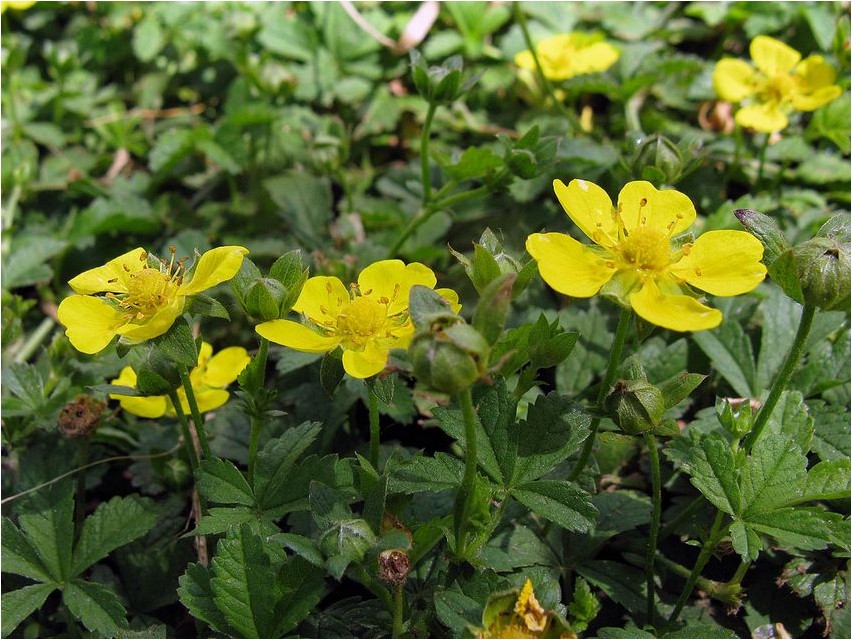
Cinquefoil is one of the plants of the family called Rosaceae; in Latin the name of this plant will be as follows: Potentilla reptans L.
As for the name of the creeping cinquefoil family itself, in Latin it will be: Rosaceae Juss.
Description of creeping cinquefoil
The creeping cinquefoil is also known by the following popular names: mogina, toadweed, toadwort, five-leaved liverwort, five-leaved liverwort, five-fiddled flower and mighty five-leafed plant. Cinquefoil is a perennial herbaceous plant whose height will vary between thirty and sixty centimeters. Such a plant will be endowed with a woody black-brown rhizome and creeping, thin stems that will take root at the nodes. The leaves of Creeping Potentilla are five-fingered and petiolate, they will be endowed with obovate and large-finger leaflets. The flowers of this plant are painted in golden-yellow tones, they are on long stalks with a cup, and also sit singly in the very axils of the leaves. The fruit of the cinquefoil is a composite achene.
Creeping cinquefoil blooms from May to August. Under natural conditions, this plant is found in Ukraine, Belarus, in many regions of the European part of Russia, Central Asia and the Caucasus. For growth, this plant prefers the banks of reservoirs and ditches, wet places and damp meadows.
Description of the medicinal properties of creeping cinquefoil
Creeping cinquefoil is endowed with very valuable healing properties, and it is recommended to use the rhizome and grass of this plant for medicinal purposes. The concept of grass includes the flowers, leaves and stems of this plant. It is recommended to harvest rhizomes in the autumn and spring, while grass should be harvested from June to July. It is noteworthy that the chemical composition of the creeping cinquefoil has not yet been fully studied.
However, it is known that this plant contains vitamin C, trace elements, tannins and other healing substances. Creeping cinquefoil is endowed with antimicrobial, anti-inflammatory, astringent, hemostatic, and also a weak analgesic effect. An aqueous infusion of the herb and a decoction prepared from the rhizomes of this plant are recommended for use in folk medicine for gastritis, peptic ulcers, diarrhea, bleeding gums, gastric and duodenal ulcers, as well as for chronic colitis and enterocolitis, which will be accompanied by diarrhea with a copious admixture of mucus, and in addition, such healing agents are effective even when hemoptysis, internal bleeding and bloody urine.

For peptic ulcers, it is recommended to use the following healing remedy based on Creeping Potentilla: to prepare such a remedy, it is recommended to take one tablespoon of dry herb of this plant per glass of water. The resulting product should be brought to a boil, and then boiled for about one to two minutes, left to infuse for an hour or two hours, after which this healing mixture is filtered very carefully. Take the resulting healing remedy based on Potentilla repens three times a day, one-third of a glass before meals; in addition, this decoction can also be used for rinsing the mouth. It should be noted that both methods of using such a healing agent are equally effective, and are also characterized by the same positive results when used and applied correctly.





